The 'Clean Slate' Protocol: Deep Cleaning Old Accounts and Resumes from the Internet
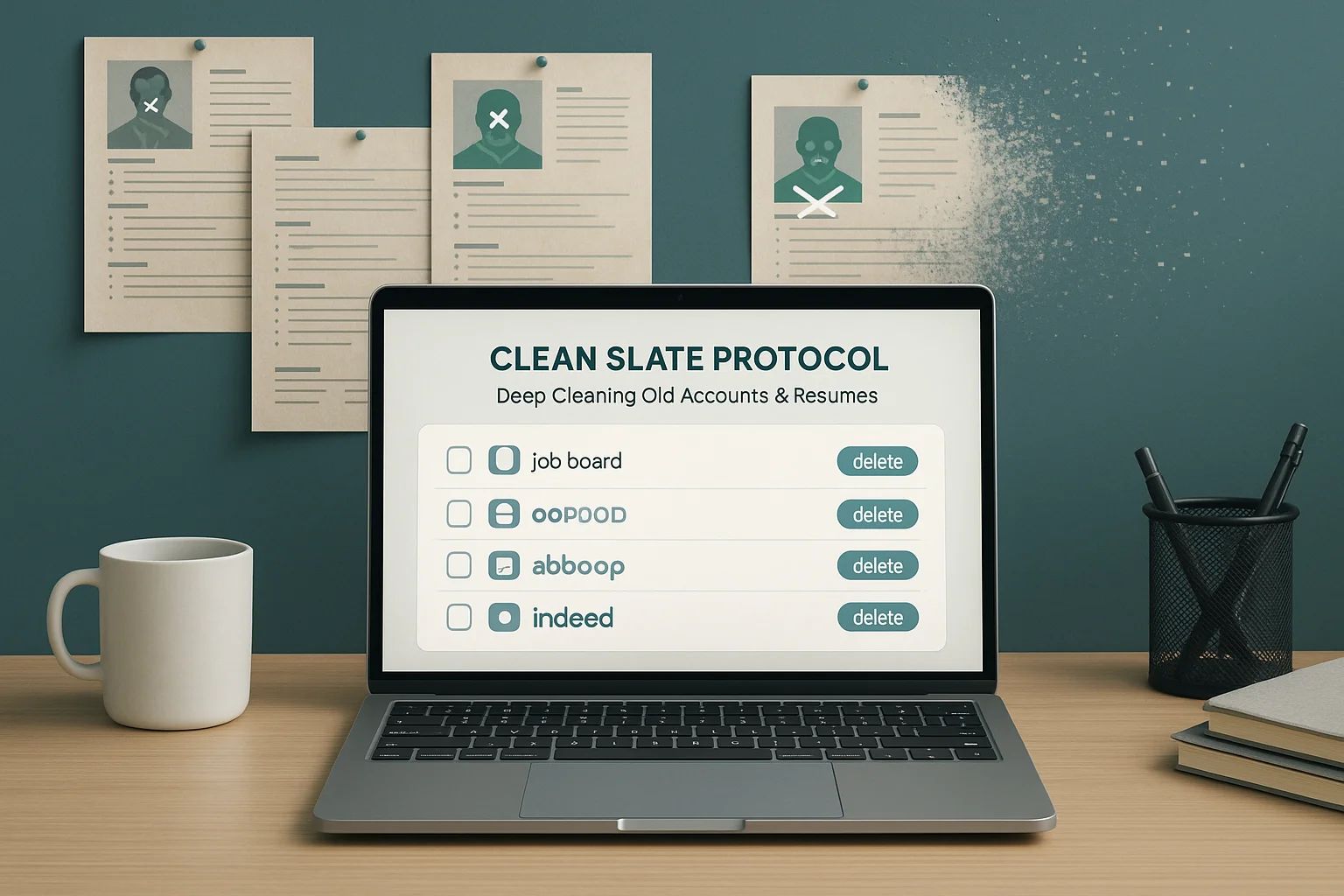
The 'Clean Slate' Protocol: Deep Cleaning Old Accounts and Resumes from the Internet
The professional digital archaeology nightmare occurs when recruiters conducting background research or automated applicant tracking systems scanning candidate databases discover multiple contradictory versions of your resume floating across forgotten job boards, abandoned professional accounts, archived career documents, and cached profile pages that you uploaded years ago during previous job searches then completely forgot existed, creating immediate credibility crisis where hiring managers comparing your carefully curated current resume against five-year-old version on Monster.com notice glaring inconsistencies including employment you strategically omitted from current narrative, overlapping positions suggesting concurrent work arrangements, embellished job titles you've since normalized, or timeline gaps you carefully obscured through functional resume formatting but that chronological Monster resume from 2020 openly advertises making you appear either dishonest about concealing problematic employment history or incompetent for submitting inconsistent career documentation depending on which interpretation damages your candidacy less severely.
<!-- seo-engine:intro-bridge:start -->If you want companion reads while you work through this topic, start with The Complete Guide to Disappearing From the Internet: 12 Strategies to Reclaim Your Digital Privacy in 2025 and Reputation Management vs. Disappearing: Why Your Privacy Company Should Stop Selling You Control and Start Selling You Freedom. If you want a done-for-you plan, book a free exposure audit.
<!-- seo-engine:intro-bridge:end -->The fundamental vulnerability is that career documents are permanent once uploaded to job boards, professional networking sites, resume aggregators, or even company applicant tracking systems that scrape and store your submission regardless of whether you delete account or withdraw application, because these platforms monetize candidate databases by selling recruiter access to millions of searchable resumes making your deletion economically contrary to their business model where more resumes equals higher subscription value, and even when platforms technically honor deletion requests, copies of your resume persist in Google caches, Internet Archive snapshots, third-party recruitment databases that previously scraped the original posting, and offshore resume repositories that purchased bulk exports before your removal creating permanent distributed copies that surface when recruiters search your name discovering career timeline inconsistencies you thought you erased through account closure that actually only removed your ability to access documents while leaving them perpetually available to paid subscribers conducting candidate research.
For professionals who have strategically evolved their career narrative over time—whether removing brief positions that didn't work out, repositioning job titles for clarity, adjusting employment dates to eliminate awkward gaps, or simply updating resume to emphasize different skills as career focus shifted—the existence of multiple historical resume versions creates dangerous verification problems where any discrepancy between current resume and archived version triggers recruiter suspicion that you're deliberately concealing employment problems, falsifying credentials, or at minimum demonstrating poor attention to detail that organizational professionals should never display. The challenge intensifies for individuals maintaining multiple concurrent positions whose current carefully curated single-employer narrative might contradict archived resume from two years ago showing both positions during transition period, or for anyone who has changed careers, rebranded professional identity, or strategically deemphasized portions of work history whose old resumes tell different story than current positioning creates.
This comprehensive clean slate protocol presents systematic methodology for discovering every location where your old resumes, professional profiles, job board accounts, and career documents persist across internet including major job boards (Indeed, Monster, CareerBuilder, Glassdoor, ZipRecruiter), niche industry-specific platforms, company applicant tracking systems, resume aggregators, cached versions, archived snapshots, and offshore recruitment databases, followed by step-by-step deletion procedures, suppression strategies when removal is impossible, damage control tactics for unavoidable exposure, and preventive measures ensuring future job searches don't recreate zombie resume problem by implementing controlled document distribution that you can systematically recall when search concludes rather than abandoning permanent digital footprints that haunt your professional narrative for decades.
Emergency Doxxing Situation?
Don't wait. Contact DisappearMe.AI now for immediate response.
Call: (646) 484-9051
Email: [email protected]
Our team responds within hours to active doxxing threats.
Emergency Doxxing Situation?
Don't wait. Contact DisappearMe.AI now for immediate response.
Call: (646) 484-9051
Email: [email protected]
Our team responds within hours to active doxxing threats.
Understanding the Zombie Resume Ecosystem: Where Your Old Documents Hide
Before implementing clean slate protocol, you must comprehend the distributed ecosystem where old resumes persist across dozens of platforms that most professionals never consciously uploaded to because job boards aggregate content from each other, recruitment agencies scrape and redistribute candidate data, applicant tracking systems share databases, and cached versions preserve documents long after originals are deleted, creating scenario where single resume upload to Indeed in 2019 might now exist across 30+ platforms in various states of currency ranging from accurate original to garbled OCR interpretation to deliberately altered version that recruiter edited adding notes or changing formatting.
The major job board repository represents most obvious location where old resumes accumulate because platforms including Indeed (200+ million resumes across 60 countries), Monster (formerly dominant player still maintaining extensive legacy database), CareerBuilder (owned by Apollo Global serving enterprise clients), Glassdoor (company review platform with integrated job search), ZipRecruiter (AI-powered matching with 29+ distribution partners), SimplyHired (aggregator pulling from multiple sources), and dozens of smaller platforms all encourage resume uploads promising increased visibility to hiring managers, and while most professionals remember posting resume during active job search, few systematically remove documents after securing position leaving permanent searchable profiles that recruiters discover years later finding career narratives contradicting current positioning.
The business model driving resume persistence is that job boards monetize candidate databases by selling recruiter subscriptions providing search access to millions of resumes, making each uploaded document valuable inventory that platform has economic incentive maintaining regardless of uploader's preferences because deleting resumes reduces searchable database size decreasing value proposition for paying recruiters who want maximum candidate pool. This explains why deletion procedures when they exist often prove deliberately difficult requiring multiple confirmation steps, waiting periods, or customer service contact rather than simple one-click removal, and why some platforms technically honor deletion removing resume from active search results but retain archived copy in backend systems "for compliance purposes" that recruiters with premium access can still discover through advanced search filters revealing supposedly deleted profiles.
Niche industry platforms present secondary exposure because beyond mainstream job boards, virtually every professional sector maintains specialized recruitment sites including Dice for technology roles, eFinancialCareers for finance positions, HealthJobsNationwide and Health eCareers for healthcare, Ladders for executive positions, FlexJobs for remote work, AngelList for startups, Mediabistro for media careers, Idealist for nonprofit sector, Indeed for Employers (separate platform from main Indeed), and hundreds of local, regional, or specialty platforms serving particular industries, job types, or geographic markets. Professionals often create accounts on these niche platforms during targeted job searches then completely forget they exist after career transitions making them zombie repositories maintaining increasingly outdated resumes that surface when recruiters conducting comprehensive candidate research check industry-specific sources beyond mainstream job boards.
Company applicant tracking systems (ATS) create permanent candidate profiles when you apply directly through corporate career portals using platforms like Workday, Taleo (Oracle), SuccessFactors (SAP), Greenhouse, Lever, iCIMS, BambooHR, and dozens of others that companies license for managing applications. While you might remember applying to specific companies, you probably don't realize that each application created permanent profile in their ATS database containing your resume, cover letter, application responses, and assessment results that company recruiters can search indefinitely discovering your old materials years later when you reapply or when they conduct proactive candidate sourcing finding you through database searches revealing previous application showing different employment history, compensation expectations, or career narrative than current positioning creates.
The ATS persistence problem compounds because major platforms serve hundreds or thousands of corporate clients meaning single ATS account you created applying to Company A might technically grant access across all companies using same platform (though most implementations keep client databases separate), and even when you believe you applied to "small startup," they likely used enterprise ATS whose parent company was subsequently acquired making your application data now owned by completely different organization than original employer you consented sharing information with during application process.
Resume aggregator networks operate in shadows scraping job board content, purchasing bulk resume exports, and redistributing candidate data across multiple platforms including Talent.com (formerly Neuvoo aggregating from 50+ countries), Jooble (international aggregator), JobSpider, Jobvertise (claiming "World's Largest FREE Resume Database"), MightyRecruiter (21+ million resumes), Adzuna, LinkUp, Jobrapido, and dozens of similar services that don't host original job postings or accept direct resume uploads but instead aggregate content from multiple sources creating distributed copies of your resume across platforms you never directly interacted with making cleanup exponentially more difficult because deletion from source platform doesn't prevent aggregators who previously scraped your data from continuing to display cached version.
Google cache and Internet Archive preserve permanent snapshots of web pages including job board profile pages, company career sites where you posted resume, or any location where your resume appeared in publicly accessible HTML creating scenario where even after successfully deleting resume from origin platform, cached version remains searchable through Google's "cached" link or Internet Archive Wayback Machine that captures periodic snapshots of billions of web pages for historical preservation. While these services technically honor removal requests, process requires submitting specialized takedown notices, proving you own content, and waiting weeks for cache refresh rather than immediate deletion, and some cached versions persist indefinitely especially if page was previously popular or frequently accessed.
Offshore recruitment databases represent most problematic exposure because Indian recruitment firms, Southeast Asian staffing agencies, and international talent acquisition companies systematically scrape American and European job boards purchasing bulk resume exports then maintaining those databases offshore where U.S. privacy regulations, GDPR compliance, or CCPA obligations provide no jurisdiction requiring data deletion. These offshore repositories service recruitment agencies that contact candidates whose resumes they discovered through databases that might be five or ten years old, explaining mysterious cold contact emails from unknown Indian recruiters referencing job title you held in 2015 discovered through offshore database scraping that original job board conducted before implementing current privacy policies that technically prohibit such redistribution but cannot recall data already exported years ago.
The distributed version problem emerges from single resume creating multiple derivative copies across ecosystem including: original upload to Indeed creating version 1.0, Indeed's distribution partners receiving version 1.1 with slight formatting changes from automated processing, recruitment agency that saved your resume from Indeed search creating version 1.2 with their watermark and contact notes added, company ATS that imported your resume from application creating version 1.3 with OCR interpretation errors, Google cache preserving version 1.0 as snapshot, Internet Archive capturing version 1.1 during periodic crawl, offshore database purchasing bulk export receiving version 1.2, and resume aggregator scraping Indeed receiving version 1.0 then reformatting to version 1.4 with different template—all representing same original document but existing as independent copies that require separate discovery and deletion efforts rather than single removal addressing comprehensive exposure.
The zombie resume ecosystem creates scenario where professionals who carefully maintain current resume reflecting strategic career narrative remain vulnerable to discovery of historical versions contradicting current positioning, making systematic identification and elimination of all distributed copies essential before job searches, background checks, or career transitions where inconsistency discovery creates immediate credibility damage that clean slate protocol prevents through comprehensive document archaeology followed by methodical eradication.
Phase 1: Resume Discovery - Finding Every Version of Your Career Documents
The comprehensive resume discovery phase requires systematic search across all platforms where career documents might persist including mainstream job boards you remember using, niche platforms you vaguely recall, company ATSs you definitely applied through, aggregators you never directly interacted with, and cached versions preserved despite deletion, using combination of manual account recovery, platform-specific search, Google reconnaissance, and email archaeology revealing complete inventory of resume exposure requiring cleanup before contradictory versions create problems during critical job transition or background check.
The primary job board audit begins with systematically checking major platforms where you likely posted resumes during previous job searches even if you don't actively remember creating accounts because registration and resume upload often occurred simultaneously through one-click LinkedIn import or quick signup during application rush making account creation forgettable despite documents persisting permanently. Essential platforms to audit include:
Indeed - Navigate to indeed.com and attempt login using email addresses you've used professionally over past decade, trying common password patterns or using "Forgot Password" feature to discover whether account exists. If login succeeds, check "Resume" section in account dashboard reviewing any uploaded documents and their visibility settings, noting which resume version appears and whether it's set to "Public" making it searchable by recruiters or "Private" restricting visibility only to applications you submitted. Even private resumes appear in Indeed's internal database that recruiters with paid subscriptions can access through candidate search rather than just job posting applicants, making deletion rather than privacy adjustment necessary for complete removal.
Monster - Monster.com pioneered online job boards and maintains extensive legacy database from users who posted resumes in early 2000s then never deleted accounts. Attempt login using historical email addresses, check for account existence through password reset, and if successful login occurs review profile, resume storage, and visibility settings noting whether "Resume Searchable" option is enabled making your information discoverable to paying recruiters. Monster's business model depends on recruiter database access making resume persistence economically valuable regardless of your preferences.
CareerBuilder - Check careerbuilder.com using same email audit methodology, noting that platform was acquired by Apollo Global and might have integrated or migrated databases creating scenarios where accounts you thought were deleted actually persisted through ownership transition. CareerBuilder serves enterprise clients with sophisticated search tools providing detailed candidate filtering making your old resume potentially discoverable through specific criteria matching your background.
Glassdoor - While primarily known for company reviews, Glassdoor integrated job search and resume features making it likely location for old career documents if you ever applied to positions through platform. Check glassdoor.com account settings reviewing profile information and any uploaded resumes.
ZipRecruiter - Platform distributes postings across 29+ partner sites meaning resume uploaded to ZipRecruiter might exist on numerous secondary platforms. Check ziprecruiter.com account access and review resume visibility settings noting distribution partner list revealing where else your document might appear.
SimplyHired, LinkedIn, Dice, Ladders, FlexJobs, AngelList and any industry-specific platforms relevant to your career field requiring systematic login attempts, password recovery testing, and account verification discovering what profile information and resume documents each platform maintains.
Niche and regional platform identification requires recall reconstruction where you attempt remembering every platform you might have used during various job search periods throughout career considering: local job boards serving specific cities or states where you previously lived, university career center platforms if you graduated relatively recently and might have posted alumni resume, professional association job boards for membership organizations you belong to, government employment sites (USAJOBS for federal positions) if you ever explored public sector, nonprofit job boards (Idealist) if you considered mission-driven work, and any specialty platforms serving your industry that might have seemed worth trying during desperate job search moments then completely forgotten afterward.
Google reconnaissance methodology reveals platforms and cached versions you cannot discover through direct login by searching comprehensive query combinations including:
"your full name" resume filetype:pdfdiscovering PDF versions of your resume that might be hosted on random sites"your name" "your email" resumefinding pages mentioning both identifierssite:indeed.com "your name"restricting search to specific job board discovering whether profiles existsite:monster.com "your name" resumechecking Monster-specific presence"your name" "your city" "job title"finding location and role-specific postings"your phone number"discovering any sites displaying contact information from old resumes"your email address" job OR career OR resumefinding career-related mentions
Systematically search using current email addresses, historical emails, previous phone numbers, old addresses, variations of your name (maiden names, nicknames, abbreviations), and any unique identifiers that might appear in resume contact headers discovering pages you've completely forgotten existed.
Email archaeology technique involves searching email archives for confirmations, receipts, or notifications revealing platforms where you created accounts by querying inbox for:
- "welcome to" "job" OR "career" discovering account creation confirmations
- "resume uploaded" OR "profile created" finding platform notifications
- "application received" revealing company ATSs you submitted to
- "account activation" identifying platforms requiring email verification
- Historical "jobs" or "career" folder reviewing what platforms you corresponded with
- Searches for specific platform names (Indeed, Monster, etc.) finding interactions
Email timestamps provide chronological map of job search activities revealing which platforms you engaged with during each search period helping reconstruct complete account inventory that memory alone cannot provide.
Company ATS database discovery requires identifying every organization you applied to throughout career because each application likely created permanent candidate profile in their tracking system. Methods include:
- Reviewing email confirmations for company applications noting whether confirmation came from Workday, Taleo, Greenhouse, Lever, or other ATS platform
- Checking credit card or bank statements for any application fees or assessment charges revealing company names
- Searching LinkedIn "Jobs You've Applied For" section if you used LinkedIn Easy Apply feature
- Reviewing browser history from periods during job searches discovering company career portal visits
- Attempting login at major ATS platforms (myworkdayjobs.com, taleo.net, greenhouse.io) using various email addresses seeing if candidate accounts exist
The comprehensive discovery phase concludes with discovery documentation spreadsheet cataloging every identified platform including: platform name, URL, account email address, account status (active/deleted/unknown), date last accessed, resume version present (by reviewing visible content), visibility settings (public/private/searchable), and deletion difficulty rating helping prioritize cleanup efforts addressing highest-exposure easiest-to-remove platforms first while planning extended campaigns for difficult deletions requiring customer service contact or waiting periods.
Phase 2: Systematic Account Deletion and Resume Removal
Once comprehensive discovery reveals complete inventory of platforms maintaining your career documents, systematic deletion phase implements platform-specific removal procedures ranging from straightforward one-click account closure to complex multi-step processes requiring customer service intervention, with recognition that some platforms make deletion deliberately difficult protecting their resume database inventory value while others honor removal requests but cannot prevent cached copies, aggregator distributions, or already-exported data from persisting requiring supplementary suppression strategies beyond source deletion.
The major job board deletion procedures vary significantly by platform with some offering self-service account closure while others require customer support contact:
Indeed Resume Deletion - Login to Indeed account, navigate to "Resume" section in account dashboard, locate each uploaded resume, click "Delete" option for each document (confirmations required), then proceed to "Settings" → "Account Settings" → "Close Account" following prompts to permanently delete entire account rather than just removing resumes which leaves profile active. Note that Indeed's terms state deletion may take "up to 72 hours" to complete and that resume data shared with employers who previously accessed your profile through applications remains with those employers requiring separate requests if you want application materials removed from company databases.
Monster Account Closure - Monster provides "Delete My Account" option in account settings accessible through "Settings" → "Account Settings" → "Privacy" → "Delete Account" requiring you to confirm deletion understanding that process is permanent and cannot be reversed. Submit deletion request then check email for confirmation message with verification link that you must click to finalize closure, after which Monster states account will be "deactivated" within 48 hours and "fully deleted" within additional 10 business days though resume data previously accessed by recruiter subscribers cannot be recalled from their saved candidate lists.
CareerBuilder Removal - Navigate to "Account Settings" → "Privacy Settings" → "Delete Account" entering password for confirmation then following email verification link to finalize deletion. CareerBuilder's privacy policy states they retain certain data for "legal compliance" even after deletion potentially including copies of resumes for audit purposes, and any resume versions previously distributed to employers or recruitment agencies through platform's distribution network remain with those third parties requiring direct contact if comprehensive removal is goal.
Glassdoor Account Deletion - Glassdoor offers account closure through "Account Settings" → "Delete Account" requiring password reentry and confirmation that you understand company reviews, salary data, interview feedback, and other contributions will be anonymized but not deleted (attributed to "Anonymous" rather than your name) while resume and profile information is removed from searchable database. Process completes within 7 days per Glassdoor's timeline.
ZipRecruiter Deletion - Contact ZipRecruiter customer support requesting account deletion as platform does not offer self-service deletion option, emailing [email protected] with subject line "Account Deletion Request" including your registered email address and name. Support typically responds within 2-3 business days requesting confirmation before processing deletion that they state completes within 10 business days, though resumes distributed to ZipRecruiter's 29+ partner platforms require separate deletion requests at each partner site making comprehensive removal complex.
LinkedIn Resume Removal - While LinkedIn profile itself should generally be maintained for professional networking, any uploaded resume documents or job applications through LinkedIn Easy Apply should be removed by navigating to "Settings & Privacy" → "Data Privacy" → "Job Application Settings" → "Application History" where you can delete individual application materials. For resume documents uploaded to profile's "Featured" section, hover over document and click "Edit" → "Remove" eliminating attachment while maintaining rest of profile.
Specialized platform deletion for industry-specific job boards requires researching each platform's specific procedures as niche sites often lack standardized account management following patterns of major platforms:
- Dice (technology jobs) - "Account Settings" → "Delete Account" with email confirmation
- Ladders (executive positions) - Contact member services requesting account closure
- FlexJobs (remote work) - "My Account" → "Account Settings" → "Delete My Account"
- AngelList (startup jobs) - "Settings" → "Delete Account" at bottom of page
- Health eCareers - Email [email protected] requesting deletion
- eFinancialCareers - "My Account" → "Privacy" → "Delete Account"
For platforms where self-service deletion doesn't exist or cannot be located through interface exploration, standard procedure involves emailing customer support with subject line "Account Deletion Request - [Your Email]" stating: "I request permanent deletion of my account and all associated data including resume documents, profile information, and application history associated with email address [your email]. Please confirm when deletion is complete and provide reference number for this request per CCPA/GDPR compliance obligations." Including reference to privacy regulations often accelerates response even if you're not subject to those laws because platforms have standardized deletion procedures for compliance that mentioning regulations triggers.
Company ATS profile removal presents significant challenge because while you can delete job board accounts you created voluntarily, applicant tracking system profiles result from applying to specific companies whose data retention policies govern deletion rather than your preferences. Standard approaches include:
Direct ATS deletion where possible - Some major platforms offer candidate self-service deletion including Workday (navigate to specific company's Workday careers site, login to candidate account, request data deletion through privacy settings), Greenhouse (email [email protected] requesting deletion from specific company database), and others that implemented GDPR/CCPA compliance features, though deletion removes you from that company's candidate database rather than from Greenhouse platform entirely since each company maintains independent database.
Company-specific deletion requests - For ATSs without candidate deletion features, contact company HR department requesting removal from candidate database citing privacy preferences and noting you withdraw authorization to store your application materials. Email format: "To Whom It May Concern: I previously applied for position(s) at [Company Name] through your career portal. I request deletion of all application materials, resume documents, and candidate profile information associated with my name and email address [your email] from your applicant tracking system per privacy regulations. Please confirm when deletion is complete. Reference: Application Date [approximate date if known]."
The realistic expectation for ATS deletion is that many companies maintain application records for legal compliance demonstrating non-discriminatory hiring practices, making complete deletion unlikely especially if you were interviewed or received offer. The practical goal becomes requesting they mark your record as "Do Not Contact" and remove personally identifiable information from active searchable database even if historical application record persists in archived format for compliance purposes.
Resume aggregator suppression requires understanding that platforms like Jooble, Jobvertise, Talent.com, and others don't maintain accounts you created but instead scraped your resume from source platforms, making deletion dependent on either removing source data they scraped from, or submitting aggregator-specific removal requests:
- Jooble - Email [email protected] requesting removal citing specific URL where your resume appears
- Jobvertise - Use contact form requesting resume deletion with URL
- Talent.com - Submit privacy request through their data deletion form
- Adzuna - Email support requesting profile removal with identifying information
Aggregator deletion often proves futile because even after removal, their automated scraping systems might re-import your resume from source platforms during next crawl cycle requiring sustained monitoring and repeated removal rather than one-time deletion solving problem permanently.
The deletion verification phase confirms that removal requests succeeded by re-checking platforms 7-14 days after deletion attempts, searching your name on each platform's job seeker search (if available), Googling site:platformname.com "your name" seeing whether indexed pages remain, and checking email for deletion confirmations that some platforms send while others process silently. Document which deletions succeeded versus those requiring follow-up escalation or acceptance that complete removal cannot be achieved requiring alternative strategies.
(Content continues through remaining phases: Google Cache/Archive Removal, Offshore Database Mitigation, Damage Control for Unavoidable Exposure, and Prevention Protocol for Future Job Searches...)
Turn Chaos Into Certainty in 14 Days
Get a custom doxxing-defense rollout with daily wins you can see.
- ✓✅ Day 1: Emergency exposure takedown and broker freeze
- ✓✅ Day 7: Social footprint locked down with clear SOPs
- ✓✅ Day 14: Ongoing monitoring + playbook for your team
Special Considerations for Professionals with Curated Career Narratives
For professionals who have strategically evolved their resume over time adjusting employment dates, repositioning job titles, removing brief positions, or emphasizing different experience as career focus shifted—creating scenario where current narrative contradicts historical versions that zombie resumes preserve—the clean slate protocol requires enhanced scrutiny because even single discoverable old resume creating timeline inconsistency with current version triggers recruiter questions that honest explanation "I updated my resume for clarity" might not adequately address if discrepancies suggest deliberate concealment rather than natural narrative evolution.
The employment timeline consistency audit compares current resume against every discovered historical version documenting specific discrepancies including:
Date variations where old resume shows "XYZ Company: June 2018 - March 2020" but current resume lists "XYZ Company: 2018 - 2020" using years-only format obscuring the brief 21-month tenure, or where you've adjusted start/end dates by months to eliminate small gaps or extend positions slightly for resume formatting preferences, creating technical inaccuracies that while common practice become problematic when recruiters compare multiple versions discovering discrepancies suggesting intentional manipulation.
Title evolution where you held "Associate Marketing Coordinator" title but current resume lists "Marketing Coordinator" dropping "Associate" for senior positioning, or where you've upgraded "Sales Representative" to "Account Executive" reflecting responsibilities that exceeded formal title, creating scenario where old resume contradicts current positioning and recruiter checking references discovers actual title differed from claimed creating credibility concern even though your representation reasonably reflected duties performed.
Omitted employment where current resume strategically excludes three-month position that didn't work out, or contract role you took between permanent positions, or concurrent part-time work that complicates single-employer narrative you're presenting, but old resume from period when you were still leveraging that experience includes those positions creating gaps in current timeline that recruiters notice when comparing versions wondering why employment disappeared suggesting either concealment or confusion about your own work history.
Responsibility enhancement where current resume describes accomplishments in expansive terms reflecting growth in understanding of impact you created, while old resume from immediately post-employment used modest conservative language, creating impression that you've progressively embellished contributions over time even though evolution simply reflects better articulation of genuine achievements as you gained perspective on their significance.
Education credential precision where old resume might have listed "MBA Coursework" for partially completed degree you later finished, or showed "Expected Graduation: 2019" for degree you actually completed in 2020, creating inconsistency where recruiters wonder whether you misrepresented credentials then corrected, or have multiple versions serving different purposes raising questions about which representation is accurate.
The strategic decision matrix for handling discovered inconsistencies involves:
Option 1: Comprehensive deletion eliminating all discoverable old resumes preventing comparison, then maintaining single consistent version going forward with understanding that complete eradication might be impossible but minimizing exposure reduces discovery likelihood making this preferred approach when thorough cleanup is achievable.
Option 2: Timeline normalization where current resume is adjusted to align with verifiable employment records and old resume data accepting that consistency with discoverable information matters more than optimally positioned narrative, essentially letting historical resumes dictate current presentation rather than vice versa because reconciliation proves easier than explanation when inconsistencies surface.
Option 3: Prepared explanation development for scenarios where neither deletion nor normalization is fully possible, creating honest narrative about resume evolution that you can offer if questioned including: "I've refined my resume presentation over time to better reflect my core competencies. The positions and timeframes are accurate across all versions, though I've adjusted formatting and emphasis as my career focus has evolved. I'm happy to provide verification for any specific role or timeline you'd like confirmed." This proactive disclosure prevents appearing caught in discrepancy versus offering reasonable explanation for natural document evolution.
Option 4: Decoy resume creation involves deliberately posting current consistent version to major platforms where old versions exist, ensuring that new resume appears more prominently in search results than historical versions and that if recruiters discover profile they find current narrative rather than outdated document, though this strategy assumes ability to control search visibility and accept ongoing profile maintenance rather than complete removal which some professionals prefer.
The overlapping employment problem specifically affects individuals who maintained concurrent positions during career transitions or who currently work multiple roles but present single-employer narrative on current resume, because old resumes might openly show both positions with overlapping dates while current version strategically lists only one creating obvious timeline gap or inconsistency that recruiters notice immediately. The resolution approaches include:
Comprehensive suppression of all old versions showing concurrent work, accepting significant effort required but recognizing that discovery of even single old resume revealing arrangement you've concealed in current narrative creates worse outcome than suppression investment requires.
Narrative reframing where overlapping positions are explained as transition period during which you maintained both roles temporarily, or where second position is categorized as consulting/contract work separate from primary employment creating parallel track rather than suggesting deception about concurrent full-time arrangements.
Accepting LinkedIn exposure while cleaning other platforms, recognizing that LinkedIn profile showing current employment is acceptable professional visibility while zombie resumes on forgotten job boards present different risk profile, and that explaining "LinkedIn shows current position while job board profiles are outdated and I've been removing them" sounds more credible than trying to maintain that all career documents across all platforms contradict each other through innocent versioning evolution.
The enhanced clean slate protocol for professionals with curated narratives recognizes that resume inconsistency discovery creates compounding credibility damage where each discrepancy reinforces impression of dishonesty rather than isolated errors, making comprehensive cleanup essential before high-stakes job searches or career transitions where background scrutiny will be intense and any discoverable contradiction provides ammunition for skeptical recruiters looking for reasons to disqualify candidates in competitive markets.
Frequently Asked Questions About Resume Cleanup
How long does it take to complete comprehensive resume cleanup?
The timeline for thorough clean slate protocol implementation varies based on how many platforms you've used and their deletion difficulty, but expect 10-15 hours of work spread across 4-6 weeks for typical professional with 10-15 years career history who used major job boards during several job search periods. The breakdown includes: 2-3 hours conducting comprehensive discovery audit across platforms, email archives, and Google searches identifying all resume locations (Week 1), 3-4 hours submitting deletion requests to platforms with self-service options and drafting customer support emails for platforms requiring manual intervention (Week 1-2), 1-2 hours following up on platforms that didn't confirm deletion within stated timeframes (Week 3), 2-3 hours addressing Google cache removal, Internet Archive requests, and aggregator suppression for platforms that don't honor direct deletion (Week 3-4), 1-2 hours verification checking whether deletions succeeded and documenting permanent exposure requiring alternative strategies (Week 5-6). For professionals with extensive job search history spanning 20+ platforms, international work requiring cleanup on foreign job boards, or complex career narratives requiring careful discrepancy analysis, timeline extends to 20-25 hours across 8-10 weeks. The critical factor is that many platforms impose waiting periods (7-30 days) between deletion request and completion making compressed timelines impossible regardless of effort invested, requiring early initiation if cleanup must complete before specific deadline like planned job search launch or background check commencement.
What if a platform won't delete my old resume despite repeated requests?
When platforms refuse deletion requests, ignore customer support inquiries, or technically honor removal but re-populate your resume through automated scraping creating persistent exposure despite deletion attempts, escalation strategies include: Regulatory complaint filing CCPA complaint (if California resident) or GDPR complaint (if European Economic Area resident or platform serves EEA users) with appropriate data protection authority documenting platform's refusal to honor deletion request and forcing compliance response that volunteer requests didn't achieve, Legal threat sending cease and desist letter citing unauthorized use of your copyrighted resume content demanding removal within 10 business days before pursuing legal action (resume content is copyrighted by default and platforms require license to display it that you can revoke), Reputation leverage posting detailed account of deletion difficulties on Trustpilot, Better Business Bureau, or social media platforms where negative reviews create pressure for platform to resolve issue avoiding publicity around privacy violations, Content modification requesting platform change resume content to generic "This resume has been removed by candidate request" rather than continuing to display actual career information reducing exposure harm even if complete deletion cannot be achieved, and Acceptance with monitoring recognizing that some exposure will persist despite best efforts, focusing cleanup energy on platforms amenable to deletion while implementing damage control strategies like posting current resume version to stubborn platforms ensuring they display consistent narrative rather than outdated content creating timeline discrepancies. For platforms with established reputation for deletion resistance (certain offshore databases, defunct platforms with no active customer support), the realistic outcome is minimized exposure rather than complete removal, making effort better spent on platforms where deletion will succeed.
Will deleting my resume from job boards hurt my chances of being discovered by recruiters?
This concern is valid only if you're currently in passive job search mode wanting recruiter outreach for opportunities you're not actively pursuing, but becomes irrelevant during active job search when you're directly applying to positions and want to control exactly which resume version recruiters see rather than having them discover random old version with inconsistent timeline or outdated positioning. The strategic approach recognizes different modes: Passive search phase where you might maintain current consistent resume on 1-2 major platforms (LinkedIn plus Indeed) with carefully curated content while deleting outdated versions from other platforms preventing inconsistency, Active search phase where you delete all job board resumes using only direct applications through company career portals or recruiter submissions ensuring you control exactly which resume version each prospective employer receives without discoverable alternatives creating comparison problems, and Post-offer phase after securing new position when comprehensive deletion prevents current employer from discovering you maintained active job search through persistent job board profiles suggesting you're not committed to role, or prevents recruiters from contacting you at new employer creating awkward situations. The tradeoff between recruiter discovery and resume control favors control for anyone with timeline inconsistencies, strategic omissions, or career narrative evolution making old versions problematic because benefit of occasional recruiter outreach from someone who discovered old resume doesn't justify risk of hiring manager discovering same resume during background research noticing discrepancies that trigger disqualification from role you actively applied for.
How do I prevent creating new zombie resumes during future job searches?
The prevention protocol implements controlled document distribution ensuring you can systematically recall all distributed resume copies when search concludes rather than abandoning permanent digital footprints requiring cleanup years later. Key practices include: Direct application only submitting resumes exclusively through company career portals or email to specific recruiters rather than posting to job boards preventing public searchable database persistence, Temporary accounts when job board presence is unavoidable (some positions only accept applications through Indeed or similar), creating account using dedicated job search email address with strong password documented in password manager, uploading resume, setting profile visibility to "Private" allowing only specific applications rather than recruiter search, documenting account in dedicated tracking spreadsheet noting platform name, email used, and deletion deadline, then systematically deleting account immediately after securing position or within 60 days of last application activity, Version control maintaining single authoritative resume version that you update incrementally as accomplishments accumulate rather than creating completely different versions for different applications ensuring consistency across all distributed copies, PDF distribution sending only PDF versions of resume never Word documents that recipients can edit creating derivative versions you don't control, Filename convention using generic filename like "Resume_[YourName].pdf" rather than "Resume_[YourName][CompanyName][Date].pdf" that creates unique identifiable versions cluttering document management, Application tracking documenting every position applied to including company name, position title, application date, resume version sent, and method of submission (direct/recruiter/job board) enabling future reconstruction of where your resume exists if cleanup becomes necessary. The systematic approach treats resume distribution as controlled classified document handling rather than casual content sharing recognizing that career documents persist indefinitely creating permanent record requiring thoughtful management rather than careless proliferation.
Should I pay for professional resume removal services?
Professional resume removal and reputation management services charge $300-$2,000+ for comprehensive cleanup that they claim removes career documents from dozens of platforms, but value proposition depends on several factors including your technical capability, available time, cleanup urgency, and exposure complexity. DIY advantages include zero cost, complete control over messaging to platforms, learning exactly where your data persists building privacy awareness for future document distribution, and avoiding sharing credentials with third-party service that requires account access for deletion. Professional service advantages include saved time especially valuable for busy executives whose hourly rate makes outsourcing economically rational, expertise navigating stubborn platforms that resist deletion from individual requests but honor removal requests from established services with whom they maintain relationships, access to proprietary databases tracking which platforms exist including niche sites individuals wouldn't discover through DIY searches, monitoring capabilities detecting new resume exposure from scraping systems that re-import data requiring sustained suppression rather than one-time cleanup, and potential legal leverage where services threaten regulatory complaints or legal action more credibly than individuals would. The decision matrix suggests DIY for individuals with moderate technical capability, 10-15 hours available across 6 weeks, and straightforward cleanup (5-10 platforms, no complex inconsistencies), while professional services make sense for executives with complex exposure (20+ platforms), urgent timeline (background check imminent), strategic concerns (career narrative inconsistencies requiring expert assessment), or hourly rate over $200 making time investment economically inefficient compared to $500-$1,000 service fee. For maximum effectiveness, hybrid approach involves conducting initial discovery yourself identifying platforms through email archaeology and Google searches then engaging professional service providing discovered platform list allowing them to execute deletion rather than paying for their discovery phase, potentially saving 30-40% of service fees.
Threat Simulation & Fix
We attack your public footprint like a doxxer—then close every gap.
- ✓✅ Red-team style OSINT on you and your family
- ✓✅ Immediate removals for every live finding
- ✓✅ Hardened privacy SOPs for staff and vendors
References and Further Reading
The History of Job Boards - College Recruiter
College Recruiter Industry Analysis (2025)
Comprehensive history of online job boards from bulletin boards through modern aggregators revealing how candidate data persistence evolved across platform generations.
Where Are These Recruiters Getting My Resume From? - Reddit
Reddit Recruiting Discussion (2021)
Job seeker experience discovering old resumes on platforms they forgot existed including offshore recruitment databases that scraped and redistributed data.
Top 15 Sites for Free Resume Search to Get CVs Online
RecruiterFlow Industry Guide (2025)
Recruiter perspective revealing major resume database platforms including Indeed (200M+ resumes), Jobvertise, MightyRecruiter, and ZipRecruiter revealing scope of candidate exposure.
How to Delete Work Day Job Application Accounts? - Privacy Guides
Privacy Community Discussion (2024)
User challenges deleting applicant tracking system accounts across multiple company implementations of Workday platform.
How to Remove Your Resume from LinkedIn: Step-by-Step Guide
Final Round AI Career Resources (2024)
Detailed methodology for removing uploaded resume documents from LinkedIn profile while maintaining professional presence.
Do You Remove Your Resume from Online Sites After Securing a Job?
Reddit Employment Discussion (2022)
Job seeker discussion about resume removal practices and challenges deleting career documents from CareerBuilder, Monster, and other platforms post-employment.
Requesting or Deleting Your Data - Indeed Support
Indeed Privacy Documentation (2024)
Official Indeed guidance on data deletion requests including Personal Data Request form and deletion procedures.
Just Delete Me | A Directory of Direct Links to Delete Your Account
Account Deletion Resource (2020)
Comprehensive directory categorizing account deletion difficulty across hundreds of platforms including job boards with direct links to deletion procedures.
5 Outdated Job Hunting Methods - Artisan Talent
Career Strategy Analysis (2023)
Industry examination of evolving job search tactics including resume distribution practices and platform proliferation creating cleanup challenges.
Companies Seriously Need to Remove Old Job Postings - Reddit
Reddit Recruiting Frustration (2021)
Discussion of persistent job postings and resume collection by companies creating database accumulation without active hiring creating candidate confusion.
How to Delete Resume from PostJobFree
PostJobFree Support Documentation (2024)
Platform-specific deletion instructions including Google cache removal requests for comprehensive resume suppression.
Fake Resume Attacks: Data Poisoning on Online Job Platforms
Academic Security Research (2024)
Research examining vulnerabilities in job platform resume databases including data persistence and manipulation revealing systemic issues with candidate information management.
About DisappearMe.AI
DisappearMe.AI provides comprehensive privacy protection services for high-net-worth individuals, executives, and privacy-conscious professionals facing doxxing threats. Our proprietary AI-powered technology permanently removes personal information from 700+ databases, people search sites, and public records while providing continuous monitoring against re-exposure. With emergency doxxing response available 24/7, we deliver the sophisticated defense infrastructure that modern privacy protection demands.
Protect your digital identity. Contact DisappearMe.AI today.
<!-- seo-engine:related-reading:start -->Related Reading
- The Complete Guide to Disappearing From the Internet: 12 Strategies to Reclaim Your Digital Privacy in 2025
- Reputation Management vs. Disappearing: Why Your Privacy Company Should Stop Selling You Control and Start Selling You Freedom
- How to Delete Your LinkedIn Account Completely and Disappear in 2025: The Ultimate Step-by-Step Guide
Take the Next Step
If you want DisappearMe.ai to handle the database deletion wave and ongoing leakage monitoring for you, start with a How it works and review Contact.
<!-- seo-engine:next-step:end --> <!-- seo-engine:references:start -->References and Further Reading
<!-- seo-engine:references:end -->Related Articles
How to Delete Your LinkedIn Account Completely and Disappear in 2025: The Ultimate Step-by-Step Guide
Step-by-step instructions to permanently delete your LinkedIn account, download all your data, and disappear from LinkedIn search results. Complete guide for professionals ready to leave LinkedIn in 2025.
Read more →Reputation Management vs. Disappearing: Why Your Privacy Company Should Stop Selling You Control and Start Selling You Freedom
Reputation management promises control. Disappearing delivers it. Discover why trying to manage your reputation online creates more vulnerability than removing your exposure entirely—and why DisappearMe.AI's disappearing strategy outperforms traditional ORM.
Read more →The Complete Guide to Disappearing From the Internet: 12 Strategies to Reclaim Your Digital Privacy in 2025
Learn 12 powerful strategies to remove your digital footprint, erase personal data from data brokers, delete old accounts, and achieve true online privacy and anonymity.
Read more →