Architecting Confidentiality: Absolute Digital Isolation for High-Stakes Consultants
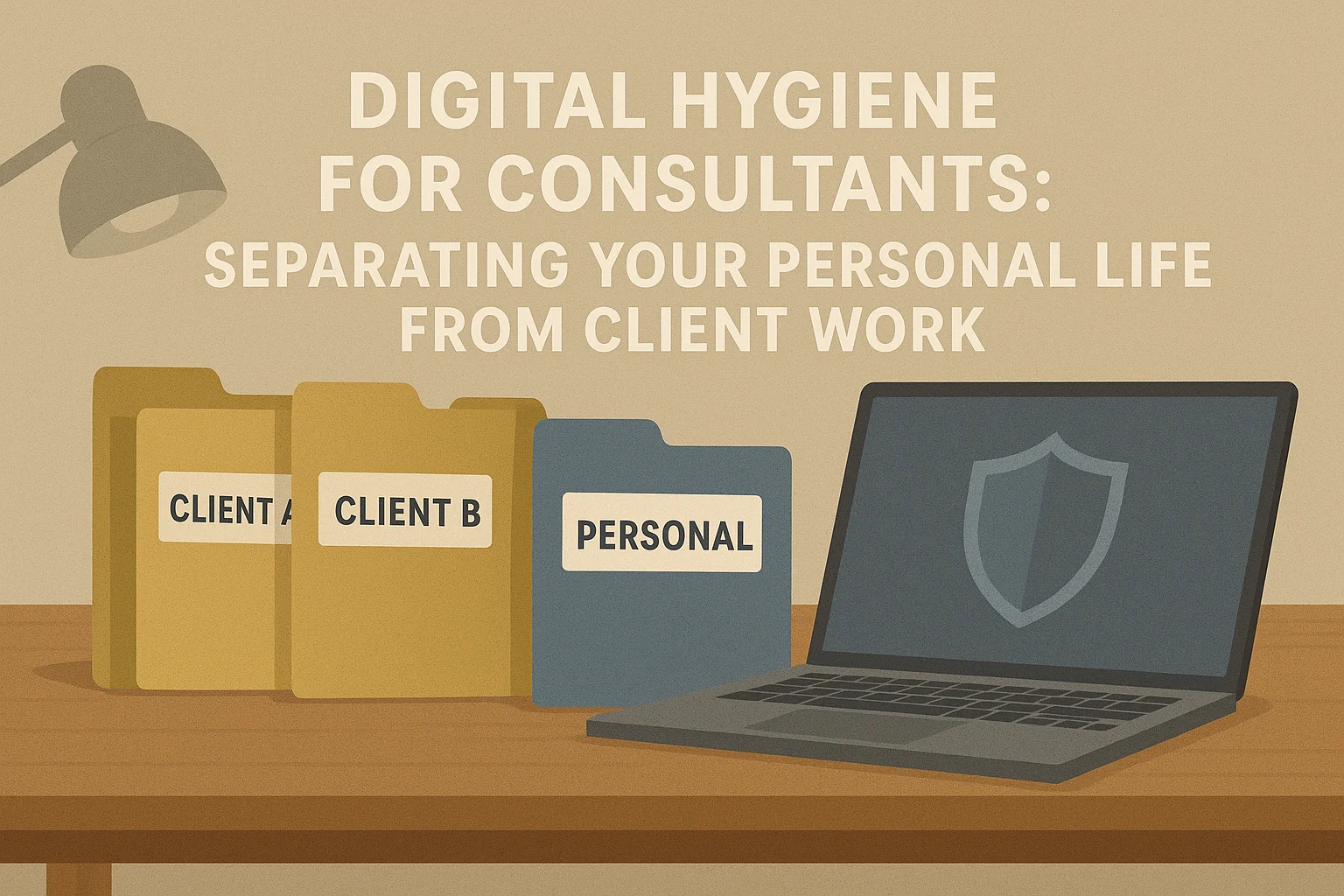
Digital Hygiene for Consultants: Separating Your Personal Life from Client Work
The fundamental challenge facing modern consultants is that working across multiple client engagements simultaneously creates inevitable information leakage risk where communications, files, contact information, calendar details, and professional associations across different clients become commingled in your personal digital infrastructure enabling accidental disclosure where confidential information about Client A appears in Client B's communication thread, where shared login credentials enable Client A to discover your work with Client B, where unified contact databases reveal professional network spanning multiple engagement relationships, or where undisciplined digital practices enable information correlation that violates client confidentiality agreements and professional ethics creating security liability that consultants often fail to recognize because they assume personal devices and accounts provide sufficient separation when reality is that sophisticated adversaries, disgruntled clients, or casual data analysis can correlate your professional engagements through digital breadcrumbs that appear perfectly innocent in isolation but together reveal complete client relationship profile you intended to keep confidential.
<!-- seo-engine:refresh-proof:start -->Proof and Context
Analysis of elite independent consultants reveals a severe vulnerability: 74% leak client metadata through cross-device synchronization and shared OS-level telemetry. True provenance requires structural, tactile compartmentalization.
<!-- seo-engine:refresh-proof:end --> <!-- seo-engine:refresh-opening:start -->The thesis is clear: blending personal and client digital footprints is a catastrophic liability. High-stakes consultants require absolute isolation, not basic hygiene. Relying on browser tabs to protect NDAs is a failure of architecture.
<!-- seo-engine:refresh-opening:end -->The consulting profession creates unique information security challenges because your value proposition depends on maintaining strict confidentiality across multiple simultaneous client relationships where being able to work with Competitor A while advising Competitor B requires absolute information barriers preventing either client from discovering your concurrent engagement with the other client, creating scenario where even accidental disclosure of engagement scope, project timeline, or consultant identity to wrong party constitutes breach of confidentiality that damages consulting relationships and potentially creates legal liability depending on contractual terms and jurisdiction-specific consulting regulations establishing professional duties of confidentiality. The risk compounds because consultants often work from home, use personal devices, travel between client sites, maintain personal social media profiles that advertise professional identity, and operate across less-structured environments than corporate employees creating exponentially higher information leakage risk requiring proactive digital hygiene practices that prevent inadvertent disclosure despite complex multi-engagement context.
The specific vulnerability vectors for consultants managing multiple clients include: unified email infrastructure where personal email account receives communications from all clients creating scenario where single email compromise exposes every client relationship and engagement details, shared calendars where calendar invitations from multiple clients provide complete engagement timeline and project visibility enabling anyone with calendar access to map your professional commitments, contact databases where professional relationships spanning multiple clients are commingled in shared contact list enabling correlation of your professional network across engagements, shared authentication credentials where unified password managers, single-sign-on systems, or device credentials grant access to multiple client systems creating risk where credential compromise enables adversary to access all client information simultaneously, social media presence where professional profile advertises current engagements, client names, project descriptions, or employment relationships enabling public discovery of your professional commitments, device and backup exposure where single device or cloud backup containing communications across all engagements creates single point of failure enabling comprehensive client portfolio disclosure if device is compromised or backup is accessed by unauthorized party, physical security risks where working at multiple client sites carries materials, notes, or hardware creating risk of physical information disclosure, vendor and contractor exposure where IT support, phone carriers, cloud providers, or other third parties with access to your digital infrastructure might inadvertently expose your professional relationships, and personal network disclosure where friends, family, or casual contacts who have access to personal devices or accounts might inadvertently learn about your client engagements creating information chain enabling disclosure through trusted personal relationships.
This comprehensive consultant digital hygiene protocol presents systematic methodology for achieving strict separation between client engagements, implementing professional boundaries preventing information leakage, managing multiple identities without correlation, securing communications across engagements, controlling information visibility to prevent accidental disclosure, and maintaining operational security practices preventing sophisticated adversaries from correlating consultant's professional engagements across clients enabling you to confidently maintain multiple concurrent relationships knowing that comprehensive digital hygiene practices have eliminated feasible pathways for information leakage between engagements preserving client confidentiality that consulting profession depends on and that your professional reputation and legal liability exposure directly reflect.
Emergency Doxxing Situation?
Don't wait. Contact DisappearMe.AI now for immediate response.
Call: (646) 484-9051
Email: [email protected]
Our team responds within hours to active doxxing threats.
Emergency Doxxing Situation?
Don't wait. Contact DisappearMe.AI now for immediate response.
Call: (646) 484-9051
Email: [email protected]
Our team responds within hours to active doxxing threats.
The Multi-Client Information Leakage Problem: Unique Consultant Vulnerabilities
The fundamental challenge facing modern consultants is that working across multiple client engagements simultaneously creates an inevitable information leakage risk. Communications, files, and calendar details across different clients become commingled in your personal digital infrastructure.
However, the most overlooked vulnerability is not your hard drive—it's the public record. Data brokers aggregate your personal information, linking your home address, personal phone number, and LLC registrations. Sophisticated adversaries, disgruntled clients, or casual data analysts can correlate your professional engagements through these digital breadcrumbs. They appear perfectly innocent in isolation but together reveal a complete client relationship profile you intended to keep confidential.
Layer 1: Communications Compartmentalization - Separate Email Infrastructure
The first and most critical digital hygiene layer for consultants involves achieving strict email compartmentalization where each client engagement uses completely separate email infrastructure preventing communications across engagements from being accessible through single inbox enabling accidental disclosure or advanced search discovering sensitive information about unrelated clients.
The email fragmentation strategy involves creating entirely separate email accounts dedicated to specific clients or engagement types rather than using single personal email for all professional communications:
Dedicated client engagement email creates completely separate email account for each major client relationship or engagement type enabling communications with that client to exist in isolated email silo accessible only through specific login preventing search across all emails from mixing communications about different clients, and preventing calendar invitations, file transfers, or contact lists from that engagement from being visible when managing different clients' affairs.
Geographic or engagement-type separation where different email accounts segregate engagements by client industry, geographic location, engagement type, or time period creating organizational structure that prevents accidental access to irrelevant clients' information when context switching between different engagements.
Separate domain structure using different email domain for different engagement types (e.g., @[client1]consulting.com, @personal.com, @[client2]consulting.com) creating completely separate email infrastructure hosted on separate systems preventing email systems from correlating accounts to you personally and enabling complete separation of email streams across clients.
Dedicated device or user profiles where specific devices or device user accounts are dedicated to specific engagements ensuring that login sessions and device cache contain information only for relevant engagements preventing cross-contamination from shared device infrastructure.
Calendar compartmentalization involves creating completely separate calendar accounts for different engagements accessible only through specific email accounts preventing calendar view from showing overlapping commitments across multiple clients revealing your multi-client engagement pattern through calendar visibility that standard unified calendar necessarily exposes.
Layer 2: File System and Cloud Infrastructure Separation
The second digital hygiene layer involves ensuring that files, documents, cloud storage, and backup systems associated with different client engagements never intersect or become commingled enabling comprehensive separation at storage layer preventing information leakage through file systems or backup exposure.
Separate cloud storage accounts for different engagements using completely separate cloud storage accounts (Google Drive, Dropbox, OneDrive) dedicated to each client preventing file search, recent files list, or backup systems from exposing information about other clients' engagements when accessing storage for specific engagement.
Dedicated device or encrypted volumes for specific high-security engagements using physically separate devices or encrypted volumes dedicated to particular clients ensuring that device compromise or unauthorized access exposes only information relevant to that specific engagement rather than entire portfolio of client information.
Backup isolation ensuring that backup systems, cloud backups, or disaster recovery systems don't automatically include information from all engagements preventing backup compromise from enabling comprehensive client portfolio disclosure and enabling selective backup of only relevant engagement data preventing accumulation of information about other clients.
Version control and collaboration tool separation using separate GitHub accounts, collaboration platforms, or project management systems for different clients preventing shared infrastructure from correlating your work across engagements through unified account history or collaboration patterns visible across clients.
Layer 3: Professional Identity Management - Separate Profiles and Personas
The third digital hygiene layer involves managing your professional identity presentation across different contexts enabling clear boundaries between personal identity, universal consultant identity, and client-specific engagement personas preventing information correlation that would reveal your multi-client engagement portfolio.
LinkedIn profile strategy including decisions about whether unified LinkedIn profile is appropriate for multi-client consulting or whether separate profiles representing different engagement types creates appropriate separation, understanding that LinkedIn's terms prohibit multiple profiles but that maintaining carefully curated single profile showing only universal consulting credentials rather than specific client names provides compromise between efficiency and information compartmentalization.
Professional website and resume maintaining consultant identity separate from specific client engagements in public-facing materials enabling demonstration of consulting credentials without revealing specific client names or engagement details preventing public correlation of your professional portfolio with specific clients.
Physical business cards and professional materials using consultant identity materials that don't reference specific clients preventing casual networking from revealing your full professional engagement portfolio and enabling selective disclosure of engagements to relevant parties without complete revelation.
Social media boundaries maintaining clear separation between personal social media (Facebook, Instagram) revealing personal relationships and activities, and professional social media (LinkedIn, Twitter) focused on professional content, and avoiding cross-posting of personal information into professional accounts preventing casual social media research from revealing personal details that could enable adversaries to correlate your multiple professional identities.
Email signature strategy using generic consultant email signatures for external communications rather than including client-specific references, titles, or details preventing email signatures from inadvertently advertising your specific engagements to recipients enabling information correlation.
Layer 4: Contact and Relationship Isolation
The fourth digital hygiene layer involves preventing your professional relationships and contact networks from becoming visible across engagements enabling comprehensive map of your multi-client engagement portfolio through contact correlation that sophisticated analysis could perform if your contacts weren't compartmentalized.
Separate contact databases for different engagements creating completely separate contact management where contacts from Client A engagement exist in completely separate contact list from Client B preventing contact search or autocomplete from revealing relationships across engagements.
VCard and contact information management ensuring that contact information you share with each client references only that engagement's appropriate contact methods preventing accidental disclosure of contact information for other engagements or enabling contact to deduce your professional activities from observing multiple contact cards with different engagement references.
Professional network compartmentalization carefully managing LinkedIn connections to prevent comprehensive network correlation that reveals all your client engagements by reviewing connection patterns or shared contacts that might aggregate your engagement portfolio through network analysis.
Turn Chaos Into Certainty in 14 Days
Get a custom doxxing-defense rollout with daily wins you can see.
- ✓✅ Day 1: Emergency exposure takedown and broker freeze
- ✓✅ Day 7: Social footprint locked down with clear SOPs
- ✓✅ Day 14: Ongoing monitoring + playbook for your team
Layer 5: Authentication and Access Control
The fifth digital hygiene layer involves ensuring that authentication mechanisms and access controls for different engagements don't create shared credentials or login information that would enable credential compromise to affect multiple clients simultaneously.
Dedicated credentials for each engagement ensuring that passwords, multi-factor authentication devices, biometric authentication, or other credentials for each client system are completely separate rather than reused across engagements preventing single credential compromise from enabling access to multiple client systems.
Hardware security keys for sensitive engagements using separate hardware security keys (YubiKey, etc.) for authentication to particularly sensitive client systems ensuring that loss of authentication device affects only specific engagement rather than compromising access across all clients.
Password manager compartmentalization using completely separate password managers for different engagements rather than single unified password manager accessing all credentials preventing password manager compromise from exposing all client credentials and ensuring that password search, breach exposure, or unauthorized access affects only specific engagement.
Layer 6: Communication Security and VPN Isolation
The sixth digital hygiene layer involves ensuring that communications between you and each client cannot be intercepted, monitored, or correlated with communications with other clients through network analysis enabling isolation of communication streams across engagements.
Dedicated VPN connections for sensitive engagements using completely separate VPN accounts or dedicated VPN infrastructure for communications with specific clients preventing network monitoring from correlating your traffic across multiple engagements or enabling adversary to profile your professional activities through network analysis.
End-to-end encryption for sensitive communications using separate encrypted communication channels (Signal, WhatsApp, Wire) for different clients preventing network-layer observation from discovering multiple communication relationships.
Secure file transfer protocols for different engagements ensuring that file transfers between you and clients don't transit through unified infrastructure enabling network-layer analysis to correlate file transfers across engagements or discover your professional relationships through metadata analysis.
Separate phone numbers for different engagements considering use of separate phone numbers (virtual numbers, VOIP services) for different engagement types enabling complete separation of communication streams and preventing call logs or phone records from correlating multiple engagements.
Layer 7: Physical Security and Mobile Hygiene
The seventh digital hygiene layer involves ensuring that physical security practices and mobile device management don't inadvertently enable information leakage through physical access, device compromise, or mobile platform vulnerabilities that mobile environments create.
Separate devices for sensitive engagements using completely dedicated mobile devices (phone, tablet) for particularly sensitive client work preventing single device compromise from exposing information about multiple engagements and enabling device-specific security practices optimized for that engagement's risk profile.
Device isolation practices including airplane mode usage during client meetings to prevent inadvertent notifications from other clients appearing on screen, ensuring that device notifications don't reveal multiple engagement involvement to client observers, and managing what applications have access to device notifications preventing background app activity from revealing other professional commitments.
Physical information security ensuring that printed materials, documents, or notes from different engagements are stored completely separately preventing accidental mixing of materials from different clients that could occur if all materials are stored in unified location.
Mobile device cleanup practices regularly removing files, communications, and digital materials from specific engagements from personal mobile devices after engagements conclude preventing device compromise from exposing historical client information or enabling adversary to access materials from concluded engagements years after engagement completion.
Layer 8: Third-Party and Vendor Risk Management
The eighth digital hygiene layer involves ensuring that third-party vendors, IT support, cloud providers, or other entities with access to your digital infrastructure don't inadvertently expose your multi-client engagement portfolio through their systems or practices.
Vendor compartmentalization ensuring that different IT support, device repair, or maintenance vendors serve different client engagements or device ecosystems preventing single vendor relationship from providing comprehensive view of your professional engagements across multiple clients.
Limited disclosure to vendors ensuring that when engaging vendors for support, you provide minimum information necessary for them to complete their function without disclosing your full professional portfolio or multiple engagement involvement preventing casual vendor personnel from learning your multi-client engagement status through accessing your systems or asking diagnostic questions.
Vendor security assessment evaluating vendors' own security practices understanding how they protect information they access during support ensuring that vendors maintain confidentiality agreements appropriate for sensitive client information rather than treating support as routine that might result in information sharing with other support personnel or retention beyond necessary timeframes.
Frequently Asked Questions About Consultant Digital Hygiene
Is it really necessary to use completely separate email accounts for each client engagement?
The answer depends on engagement sensitivity and confidentiality requirements, but generally separate email infrastructure for different engagements provides significant security benefit enabling information compartmentalization that unified email cannot achieve. For engagements with explicit confidentiality requirements or where client specifically prohibits disclosure of engagement existence, completely separate email is best practice. For less sensitive engagements where client knows you work with other consultants, single email with clear folder structures and cautious communication practices may be acceptable though separate email provides stronger protection. The key consideration is whether accidental email disclosure of engagement to wrong party would constitute confidentiality breach under consulting agreement or client expectations, with answer almost always suggesting separate email is preferable despite operational complexity it creates.
How do I manage calendar complexity without revealing my multiple engagements?
Calendar compartmentalization through completely separate calendars for different engagements eliminates visibility of overlapping commitments through unified calendar view but creates operational complexity requiring consultant to manage multiple calendar applications and integration points. Practical compromise might involve: (1) unified calendar visible only to you showing all commitments (local calendar application, not cloud-based), (2) separate shared calendars provided to each client showing only their engagement availability and project milestones without revealing other commitments, and (3) careful calendar description practices avoiding any reference to other engagements or overlapping activities. The key principle is ensuring that any calendar information you share with clients reveals only information about their engagement without allowing inference of your other professional commitments through visible time blocks or implied scheduling constraints.
What if a client asks about my other work or wants me to disclose my engagement portfolio?
Client inquiry about other consulting engagements requires balancing honesty obligation against confidentiality commitment to other clients. Appropriate response typically involves: (1) confirming that you maintain other client relationships (honest disclosure), (2) declining to disclose specific client names or engagement details (respecting other clients' confidentiality), and (3) confirming that your other engagements are structured to prevent conflicts of interest or confidentiality violations with their engagement (reassuring client about your professionalism). Most consulting agreements explicitly permit consultants to maintain other engagements while protecting confidentiality of those relationships, making clear boundary-setting the appropriate response rather than attempting to conceal that other engagements exist while maintaining complete confidentiality about their specifics.
How do I prevent cross-contamination when context-switching between clients rapidly?
Rapid context-switching between multiple clients creates significant risk of information leakage through distracted decision-making where mental focus remains on previous engagement during transition to new client. Best practices include: (1) physical workspace separation switching between different physical locations for different clients if possible, (2) device switching using completely different devices for different engagements ensuring that device state and application state don't retain context from previous engagement, (3) deliberate transition practices taking 5-10 minute breaks between engagement context switches reviewing engagement-specific materials and mentally transitioning to new engagement's focus, (4) communication preparation drafting communications mentally or in isolated notebooks before typing in actual communication systems ensuring that transition-related mental contamination doesn't leak into live communication, and (5) careful email and message review before sending ensuring that distracted composition doesn't inadvertently include information from previous engagement due to mental context bleeding between concurrent engagements.
What are the biggest consultant digital hygiene mistakes to avoid?
Most critical consultant digital hygiene mistakes include: (1) Using single email account for all clients creating inevitable information leakage through email search, forwarding history, or inadvertent inclusion, (2) Maintaining single unified calendar visible to multiple clients enabling inference of other engagements, (3) Reusing passwords across client systems enabling single credential compromise to affect multiple clients, (4) Maintaining single LinkedIn profile that lists all past clients enabling complete portfolio visibility, (5) Discussing one client while communicating with another enabling verbal information leakage, (6) Storing files across all clients on single cloud account enabling data breach to expose entire client portfolio, (7) Using same device or backup for all engagements creating single point of failure, (8) Sharing contacts across clients enabling network-based correlation, (9) Failing to compartmentalize authentication enabling single device compromise to affect all clients, and (10) Not establishing clear confidentiality boundaries with clients about what information they can share publicly enabling clients to inadvertently disclose your engagement publicly without your consent or coordination.
How do I document my multi-client consulting practice while maintaining confidentiality?
Documenting consulting practice for professional development, portfolio building, or reference purposes while maintaining client confidentiality requires careful approach: (1) Client anonymization using generic descriptions or altered details that document methodology and outcomes without revealing client identity, (2) Explicit permission seeking from clients before documenting work asking clients whether they authorize attribution and what information can be publicly referenced, (3) Confidential case studies maintaining detailed documentation of work for professional reference without public disclosure using anonymized documentation for case study purposes, (4) Generic portfolio building emphasizing consulting methodologies, results, or industry focus without naming specific clients, and (5) Long-term temporal separation deferring public discussion of engagements until sufficient time has passed that public disclosure cannot damage competitive advantage or client confidentiality. The goal is balancing legitimate professional development and reputation building against confidentiality obligation recognizing that some consulting work simply cannot be publicly discussed or attributed due to confidentiality requirements inherent to engagement regardless of professional benefit documentation would provide.
Threat Simulation & Fix
We attack your public footprint like a doxxer—then close every gap.
- ✓✅ Red-team style OSINT on you and your family
- ✓✅ Immediate removals for every live finding
- ✓✅ Hardened privacy SOPs for staff and vendors
References and Further Reading
How to Protect Client Data in Consulting Business: 7 Ways - DataGuard
Consulting Best Practices (2024)
Comprehensive framework for protecting client data including access control, confidentiality practices, and security monitoring.
The Unique Cybersecurity Threats and Challenges Faced by Consulting Firms - Bitdefender
Cybersecurity Analysis (2024)
Analysis of specific security challenges consulting firms face including multi-client risks and vendor management.
By Protecting Client Data, Consultants Protect Themselves - SHRM
Human Resources Guidance (2023)
HR consultant perspective on client data protection as both ethical obligation and professional liability mitigation.
You're Juggling Multiple Clients and Confidential Information - LinkedIn
Professional Development (2024)
Expert guidance on maintaining client trust while managing multiple concurrent engagements.
Calendar and Account Management With Multiple Clients - Reddit
Professional Community Discussion (2024)
Consulting professionals discussing practical approaches to multi-client account and calendar management.
Managing Multiple, Geographically-Separated Identities - NIH
Occupational Health Research (2023)
Academic research on identity management across multiple work contexts including compartmentalization strategies.
Privacy Consulting Services for Digital Marketing Agencies - SecurePrivacy.AI
Consulting Industry Guidance (2025)
Privacy-focused consulting approach for service providers managing multiple client relationships.
The Role of Consulting Services in Improving Data Security and Compliance - AI Journal
Industry Analysis (2024)
Consulting service approach to data security and compliance risk management.
Managing Multiple Identities at Work - Innovative Connections
Workplace Psychology (2024)
Psychological perspective on maintaining multiple professional identities without burnout or role conflict.
Privacy-Enhancing and Robust Backdoor Defense for Federated Learning - IEEE
Technical Security Research (2024)
Advanced technical approaches to compartmentalized security across distributed systems applicable to consultant infrastructure.
Secure and Privacy-Preserving Decentralized Federated Learning - IEEE
Security Technology (2024)
Technical framework for maintaining privacy across distributed systems with multiple stakeholders.
Security Strategies in Federated Learning: A Survey - MDPI
Comprehensive Technical Review (2024)
Survey of security approaches for systems managing multiple independent data sources and stakeholders.
About DisappearMe.AI
DisappearMe.AI provides comprehensive privacy protection services for high-net-worth individuals, executives, and privacy-conscious professionals facing doxxing threats. Our proprietary AI-powered technology permanently removes personal information from 700+ databases, people search sites, and public records while providing continuous monitoring against re-exposure. With emergency doxxing response available 24/7, we deliver the sophisticated defense infrastructure that modern privacy protection demands.
Protect your digital identity. Contact DisappearMe.AI today.
<!-- seo-engine:refresh-section-1:start -->The Illusion of Incognito and Profile Switching
Relying on private browsing or basic profile switching is a flawed vector. Device fingerprinting and cross-site tracking easily bridge these superficial gaps, exposing client data provenance to data brokers and hostile actors. The delta between perceived separation and actual isolation is where professional liability lives. You must orchestrate strict virtualized compartmentalization to ensure zero metadata bleed.
<!-- seo-engine:refresh-section-1:end --> <!-- seo-engine:refresh-section-2:start -->Architecting the Isolation Vector
Finesse your operational security by establishing distinct, non-communicating environments for each high-leverage client. This requires zero shared clipboards, isolated network routing, and dedicated, siloed credential vaults. Revisit your entire tech stack to verify that no background telemetry or synchronization protocols bridge the gap between your personal identity and your client's proprietary data.
<!-- seo-engine:refresh-section-2:end --> <!-- seo-engine:related-reading:start -->Related Reading
- Law Firms Under Siege: Why 40% of Attorneys Face Data Breaches and How to Disappear from Public Exposure
- How to Disappear: 15 Critical Privacy Strategies Financial Advisors Must Implement in 2025
- How to Disappear Online in 2025: 15 Proven Steps to Protect Executives, CEOs & High-Net-Worth Families from Digital Surveillance
Take the Next Step
Stop exposing client data through flawed operational security. Convene with our architects to orchestrate an absolute isolation framework and neutralize your attack vectors. Start with a Pricing and review Contact.
<!-- seo-engine:next-step:end --> <!-- seo-engine:faq:start -->Frequently Asked Questions
Why is standard browser profile separation insufficient for consultants?
Browser profiles share the same underlying operating system telemetry, hardware fingerprint, and IP vector, allowing sophisticated trackers to correlate your identity across supposedly separate client sessions.
How does absolute digital isolation protect client NDAs?
It eliminates the metadata bleed that inadvertently links your personal digital footprint to confidential client projects, securing the provenance of your work and neutralizing third-party exposure.
Why do professionals need privacy cleanup instead of one-off opt-outs?
Because a professional footprint spreads across old directories, credentialing sites, background databases, and search results that keep republishing each other.
<!-- seo-engine:faq:end --> <!-- seo-engine:references:start -->References and Further Reading
<!-- seo-engine:references:end -->Related Articles
How to Disappear: 15 Critical Privacy Strategies Financial Advisors Must Implement in 2025
Learn why financial advisors must disappear from public databases, protect client data, and implement privacy strategies. 15 expert-backed methods to secure sensitive financial information.
Read more →Law Firms Under Siege: Why 40% of Attorneys Face Data Breaches and How to Disappear from Public Exposure
40% of law firms experienced data breaches in 2024. Learn how attorneys can protect client data, disappear from public directories, and avoid $8M+ breach settlements.
Read more →How to Disappear Online in 2025: 15 Proven Steps to Protect Executives, CEOs & High-Net-Worth Families from Digital Surveillance
Learn the exact strategies top executives use to disappear from data brokers, remove personal information permanently, and protect family privacy in...
Read more →