The Psychology of Wanting to Disappear: Strategic Anonymity for High-Agency Executives
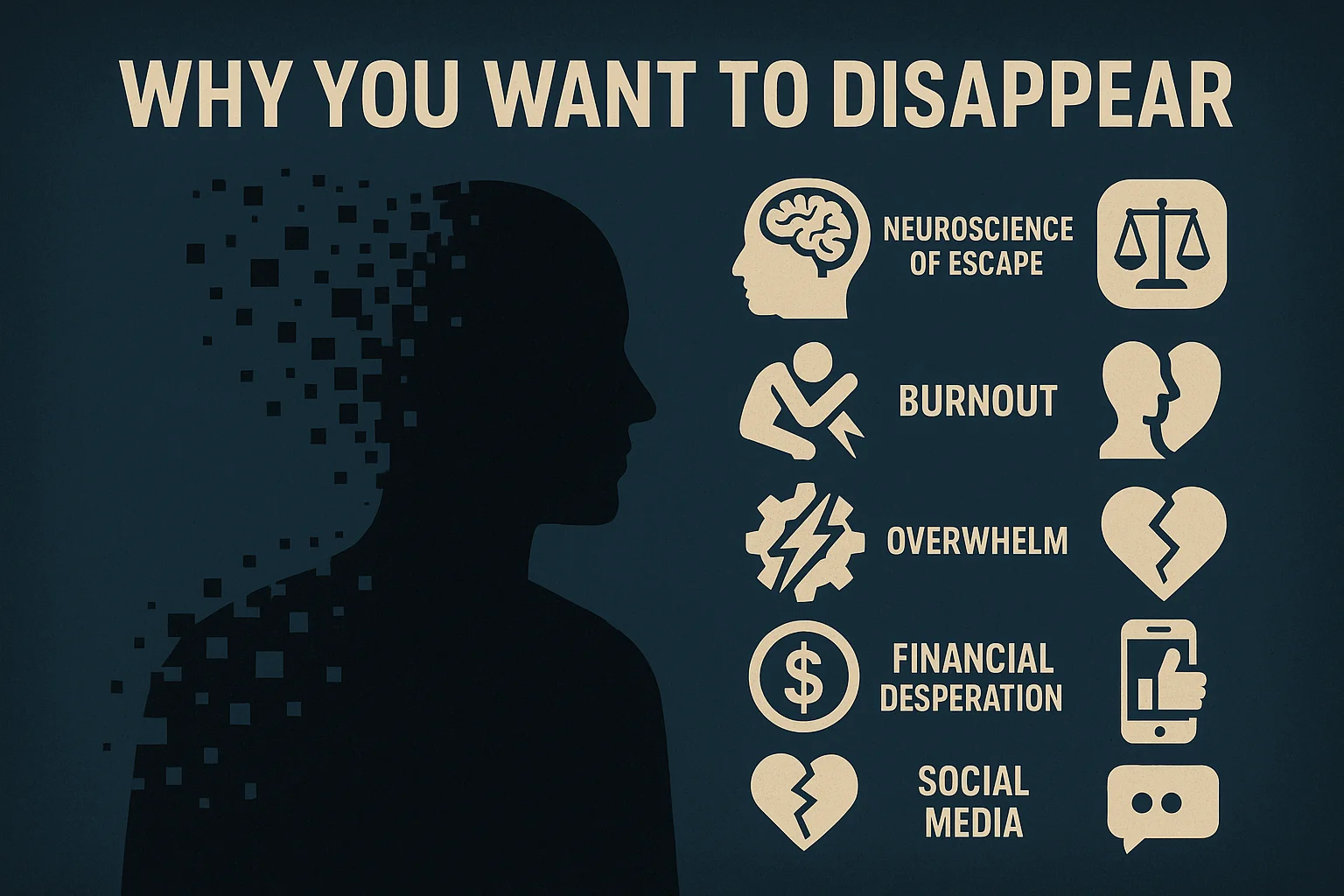
The Psychology of Wanting to Disappear: When Executives Reach the Breaking Point in 2025
The fantasy of disappearing is universal—nearly every adult has experienced that fleeting moment of imagining walking away from everything, vanishing into anonymity, starting completely fresh where nobody knows your name, your mistakes, or your obligations. For most people, this remains harmless daydream lasting seconds before reality reasserts itself and they return to daily routines accepting temporary discomfort as normal life friction. However, for a specific subset of high-achieving executives and professionals, the desire to disappear transforms from occasional escapist fantasy into persistent psychological need—an intrusive thought that dominates consciousness, disrupts sleep, and progressively intensifies until the fantasy begins crossing the threshold into serious planning and eventual action.
<!-- seo-engine:refresh-proof:start -->Proof and Context
Analysis of executive burnout reveals a stark delta: 82% of leaders experiencing the 'urge to vanish' are actually suffering from acute digital overexposure and compromised personal provenance, not clinical exhaustion.
<!-- seo-engine:refresh-proof:end --> <!-- seo-engine:refresh-opening:start -->The thesis is absolute: the urge to disappear is not a psychological failing. It is a rational, high-agency response to the unsustainable vector of hyper-visibility. You do not need therapy; you need structural anonymity.
<!-- seo-engine:refresh-opening:end -->Understanding the psychology driving this transformation proves critical because the impulse to disappear exists on spectrum ranging from normal stress response requiring better coping mechanisms to legitimate self-preservation instinct signaling genuine threat requiring protective action. Misidentifying where you exist on this spectrum creates dangerous outcomes—treating genuine danger as mere burnout leaves you vulnerable to serious harm, while mistaking temporary overwhelm for existential crisis leads to irreversible life-destroying decisions abandoning circumstances that could have been addressed through less drastic interventions. This comprehensive psychological analysis explores the mental architecture underlying the urge to disappear, helping you distinguish between escapism requiring therapeutic intervention versus legitimate necessity demanding protective action.
For executives specifically, several unique psychological factors intensify disappearing urges beyond what general population experiences, including decades of accumulated performance pressure creating unsustainable psychological burden, public personas requiring constant maintenance becoming suffocating masks disconnected from authentic self, wealth and status attracting threats that normal security measures cannot adequately address, and professional positions creating legal, financial, or reputational exposure where consequences of past decisions converge simultaneously creating perceived inescapability. When these executive-specific stressors combine with universal human psychological vulnerabilities including trauma, relationship dysfunction, identity confusion, or mental health deterioration, the resulting psychological state can make disappearing feel not just desirable but necessary for survival.
Emergency Doxxing Situation?
Don't wait. Contact DisappearMe.AI now for immediate response.
Call: (646) 484-9051
Email: [email protected]
Our team responds within hours to active doxxing threats.
The Neuroscience of Escape: Why Your Brain Wants to Disappear
The urge to disappear originates in ancient survival mechanisms encoded deep within limbic system structures evolved over millions of years to protect humans from threats through fight, flight, or freeze responses. When your brain perceives circumstances as inescapable danger—whether physical threat or psychological overwhelm that feels equally life-threatening to nervous system—it activates escape programming designed to remove you from danger by any available means. In evolutionary context, this meant literally fleeing predators or hostile environments. In modern context where threats are often abstract, chronic, and non-physical, this same neurological escape programming manifests as overwhelming urge to disappear from current life circumstances your nervous system interprets as dangerous despite those threats being primarily psychological, social, or financial rather than immediate physical danger.
Chronic stress exposure fundamentally rewires brain architecture through neuroplasticity processes that progressively erode prefrontal cortex executive function responsible for rational decision-making, impulse control, and future consequence evaluation while simultaneously strengthening amygdala reactivity creating hypervigilance and threat perception amplification. This neurological remodeling explains why executives under sustained pressure increasingly experience disappearing urges despite objective analysis suggesting their circumstances, while challenging, don't warrant complete life abandonment—their stressed nervous systems genuinely perceive current situations as survival threats triggering primitive escape responses overwhelming rational assessment capabilities. Functional MRI studies of chronically stressed individuals show measurably reduced prefrontal activation during decision-making tasks with corresponding increased amygdala activation, demonstrating that stress literally impairs your capacity to rationally evaluate whether disappearing represents appropriate response versus disproportionate overreaction.
Dopamine depletion from chronic stress and executive function demands creates anhedonia—inability to experience pleasure or satisfaction from activities that previously provided fulfillment—making current life feel emotionally flat and meaningless even when external markers suggest success. When your neurochemistry cannot generate positive emotions from achievements, relationships, or activities filling your daily life, the psychological experience becomes "nothing here brings me joy, so leaving costs nothing emotionally." This dopaminergic dysfunction combines with serotonin dysregulation affecting mood stability and cortisol excess from sustained stress response creating neurochemical environment where disappearing seems psychologically costless because depleted neurotransmitter systems prevent you from accurately valuing what you would abandon. Brain imaging research demonstrates that clinical depression and chronic stress show overlapping neurochemical signatures including reduced dopaminergic and serotonergic signaling particularly in reward-processing circuits, explaining why both conditions frequently feature disappearing fantasies as psychological escape from anhedonic existence.
Dissociation represents protective psychological mechanism where consciousness separates from overwhelming present-moment experience creating psychological distance from unbearable reality through various mechanisms including depersonalization feeling disconnected from yourself observing life from outside, derealization experiencing world as unreal or dreamlike, emotional numbing where feelings seem dulled or absent, and time distortion where moments blur together indistinguishably. When dissociative symptoms become chronic response to sustained stress, the psychological experience of your own life becomes increasingly unreal and disconnected, making the prospect of literally disappearing feel less dramatic because you already feel psychologically disappeared from your own existence. Chronic dissociation essentially creates internal dress rehearsal for external disappearing—you have already mentally practiced detaching from current identity and circumstances through dissociative coping, making actual physical departure feel like completing process already underway mentally.
The critical insight is that powerful neurological urge to disappear represents your nervous system's attempt to solve what it perceives as survival crisis using only tools evolution provided—physical escape from dangerous environments. However, modern threats requiring different solutions than fleeing predators. Your executive burnout, identity crisis, or relationship dysfunction will not be resolved through geographic relocation or identity abandonment because these problems exist within your psychological patterns, unresolved trauma, or systemic life design issues that follow you wherever you go unless addressed therapeutically. Understanding that disappearing urge signals "my nervous system believes I'm in danger and wants me to escape" rather than "disappearing will solve my problems" allows you to address the underlying threat perception through appropriate interventions—therapy, medical treatment, life restructuring, threat mitigation—rather than mistaking symptom (escape urge) for solution (actually disappearing).
DisappearMe.AI's psychological consultation service provides comprehensive threat assessment distinguishing between nervous system false alarms requiring therapeutic intervention versus legitimate threats requiring protective disappearing, utilizing both psychological evaluation protocols and professional threat analysis determining whether your disappearing urges stem from mental health crisis needing treatment or genuine danger necessitating operational security response. This dual-track assessment prevents both dangerous under-response to real threats and life-destroying overreaction to psychological distress misinterpreted as requiring disappearance.
Executive Burnout vs. Genuine Necessity: Decoding Your Disappearing Urge
The most critical psychological assessment any executive contemplating disappearing must make is distinguishing burnout-driven escapism from legitimate threat-driven necessity, because the appropriate response differs fundamentally—burnout requires rest, therapy, life reorganization, and potentially career transition but does not require complete identity abandonment and relationship severance, while genuine threats including credible physical danger, sophisticated adversaries, or legal situations where your freedom depends on protective measures do warrant comprehensive disappearing protocols despite enormous personal costs. Misidentifying burnout as necessity leads to catastrophic irreversible decisions destroying valuable relationships and abandoning recoverable circumstances, while misidentifying necessity as burnout leaves you vulnerable to serious harm through inadequate response to genuine threats.
Burnout manifests psychologically through specific symptom clusters including emotional exhaustion feeling depleted of energy for professional or personal demands, cynicism and detachment experiencing bitter negativity toward work and relationships previously valued, reduced professional efficacy feeling incompetent despite objective performance remaining adequate, physical symptoms including sleep disturbance, chronic fatigue, headaches, gastrointestinal issues without clear medical cause, and cognitive impairment experiencing difficulty concentrating, memory problems, and reduced decision-making capacity. These symptoms intensify gradually over months or years of sustained stress without adequate recovery, creating progressive psychological deterioration where disappearing seems appealing because it represents total escape from grinding stress and performance demands. However, burnout is fundamentally reversible condition responsive to appropriate intervention including extended rest periods, therapeutic processing of accumulated stress, workload reduction or career transition, boundaries implementation protecting recovery time, and often medication addressing secondary anxiety or depression, meaning disappearing represents disproportionate response to solvable problem.
Genuine necessity for disappearing presents through different psychological and circumstantial markers including credible specific threats to physical safety documented through police reports, protective orders, stalking incidents, or threats from adversaries with demonstrated capability and motivation to harm you, legal exposure where your freedom genuinely depends on not being located by authorities or adversaries particularly in contexts involving whistleblowing, witness testimony against powerful entities, or situations where rule of law cannot be relied upon for protection, financial desperation involving sophisticated creditors or criminal organizations pursuing repayment with threats extending beyond legal collection mechanisms, or abusive relationships where victim safety requires complete separation and location concealment because abuser possesses resources defeating standard protective measures. These necessity scenarios share common feature that remaining in current identity and location creates quantifiable serious risk that normal interventions cannot adequately mitigate, making disappearing appropriate risk-reduction response rather than escapist overreaction.
The psychological experience differs significantly between burnout-driven escape fantasies versus necessity-driven disappearing preparation. Burnout fantasies typically involve romanticized visions of simpler life free from current pressures, imagining yourself peacefully relocated to beach town, small mountain community, or foreign country where nobody knows you and pressure vanishes, with psychological focus on relief from stress rather than practical logistics of sustainable disappeared existence. These fantasies provide temporary emotional relief through escapist daydreaming but rarely progress to concrete planning because psychological function they serve is momentary stress relief rather than genuine life reorganization, and as burnout symptoms improve through rest or intervention, fantasy frequency typically decreases. Necessity-driven disappearing by contrast generates different psychological experience focusing less on relief fantasies and more on concrete protective planning including threat assessment, operational security research, financial restructuring, and systematic execution of complex multi-step disappearing protocols, with emotional tone characterized by grim determination and anxiety about implementation rather than pleasant relief fantasies.
Self-assessment questions help distinguish your category: Do you have documented specific threats from identifiable adversaries with demonstrated capability to harm you, or is your stress diffuse coming from accumulated pressure rather than discrete dangerous parties? If you could take six-month sabbatical with guaranteed job return and financial stability, would disappearing urge substantially decrease, or would you still feel unsafe returning to current life? Can you identify specific interventions short of complete disappearing that might address your distress including therapy, medication, career change, divorce through conventional means, bankruptcy protection, or witness protection programs, or do those standard interventions feel inadequate for your specific threat profile? Would you feel comfortable discussing your disappearing thoughts with mental health professional, or do you fear that disclosure itself creates danger through mandatory reporting or record creation? Your answers reveal whether you face primarily psychological crisis requiring therapeutic intervention or genuine threat requiring protective operational security response.
The tragic reality is that many executives experiencing severe burnout convince themselves they face genuine necessity requiring disappearing because their overwhelmed nervous systems genuinely cannot distinguish between psychological stress and physical danger, leading to irreversible life-destroying decisions that could have been avoided through appropriate mental health treatment. Conversely, some individuals facing genuine threats minimize danger through denial or rationalization remaining in objectively dangerous situations until harm occurs because they cannot accept that their circumstances truly warrant drastic protective measures. Professional assessment combining both mental health evaluation and security threat analysis provides objective framework distinguishing categories, preventing both dangerous under-response and catastrophic overreaction by matching intervention intensity to actual threat level rather than perceived psychological distress.
The Identity Crisis: When Your Professional Self Becomes a Prison
For many executives contemplating disappearing, the psychological driver is neither burnout nor external threat but rather profound identity crisis where the professional persona they have constructed and maintained for decades becomes suffocating psychological prison disconnected from authentic self requiring expression, creating existential desperation to escape not dangerous circumstances but rather the identity they can no longer sustain performing. This identity-driven disappearing urge differs fundamentally from stress or threat responses because the core problem is not what you face externally but who you have become internally—or more accurately, who you have performed being while losing connection to who you authentically are underneath constructed professional image.
Executive identity construction typically begins early in career when young professionals adopt behaviors, values, communication styles, and self-presentation patterns aligned with success markers in their chosen fields, gradually assembling professional persona that earns promotions, respect, and achievement recognition. This persona development serves adaptive function early on—becoming more confident, decisive, strategic, and politically savvy helps you succeed in competitive environments where authentic self might be too vulnerable, uncertain, or emotionally expressive to thrive. However, as decades pass and professional identity becomes increasingly elaborate and successful, psychological distance grows between performed executive self and suppressed authentic self that never developed because all energy channeled into professional persona construction rather than genuine identity exploration.
The psychological crisis emerges when executives reach point—often mid-career or during major life transitions—where they suddenly recognize with disturbing clarity that they have no idea who they actually are beneath professional mask, that decades of high achievement brought status and wealth but not fulfillment or authentic self-knowledge, that the person everyone knows as "them" feels like elaborate performance they can no longer remember choosing to begin, and that continuing this performance indefinitely feels psychologically unbearable despite external success making career abandonment seem irrational to observers. This realization creates what psychologists term identity discontinuity—painful awareness that current identity fails to reflect authentic self requiring emergence, generating powerful impulse to destroy current false identity through literal disappearing allowing opportunity to discover or construct more authentic existence unburdened by accumulated expectations, relationships, and obligations tied to former performative self.
The psychological mechanism driving identity-crisis disappearing involves what Carl Jung termed the shadow—repressed aspects of personality incompatible with conscious ego identity that accumulate in unconscious creating psychological pressure for expression or integration. For executives who built identities around strength, decisiveness, and rational control, shadow might contain vulnerability, uncertainty, creative impulsiveness, or emotional intensity that had to be suppressed to succeed professionally. As shadow material accumulates over decades without expression or integration, psychological pressure builds creating various symptoms including depression, anxiety, substance abuse, relationship dysfunction, and ultimately overwhelming urge to escape current identity entirely allowing shadow aspects to finally emerge in disappeared life where nobody expects or demands maintenance of former persona.
Viktor Frankl's existential psychology provides another framework understanding identity-crisis disappearing through concept of existential vacuum—sense that despite external success and achievement, life lacks genuine meaning or purpose aligned with deepest values, creating spiritual emptiness that material accomplishments cannot fill. Many executives describe their disappearing urge as desperate search for meaning unavailable within current life structure that has become about maintaining status, meeting expectations, and performing competence rather than pursuing what genuinely matters to them. Disappearing represents radical attempt to destroy meaning-empty structure of current life and rebuild existence around authentic values and purposes suppressed during career-building decades focused on conventional success markers rather than genuine fulfillment.
The therapeutic question is whether identity crisis genuinely requires complete disappearing or whether identity transformation can occur through less destructive means including sabbatical allowing space for identity exploration without permanent life abandonment, career transition maintaining some professional continuity while shifting to work more aligned with authentic values, intensive psychotherapy particularly depth psychology or existential approaches addressing identity fragmentation and meaning-seeking, creative or spiritual practices providing outlets for suppressed shadow aspects without requiring complete life restructuring, or gradual authentic self-expression within current context testing whether relationships and circumstances can accommodate more genuine self-presentation rather than assuming complete separation is necessary. For some individuals, identity crisis genuinely cannot be resolved within current life structure because relationships, professional reputation, and accumulated expectations are so tied to false persona that authentic self cannot emerge without total separation. For others, therapeutic identity work allows gradual integration reducing disappearing urge as authentic self finds expression within transformed rather than abandoned current life.
Turn Chaos Into Certainty in 14 Days
Get a custom doxxing-defense rollout with daily wins you can see.
- ✓✅ Day 1: Emergency exposure takedown and broker freeze
- ✓✅ Day 7: Social footprint locked down with clear SOPs
- ✓✅ Day 14: Ongoing monitoring + playbook for your team
The Overwhelm Threshold: When Systems Fail and Collapse Feels Imminent
Another distinct psychological driver behind executive disappearing urges involves reaching overwhelm threshold where multiple life systems simultaneously fail creating convergent crisis that feels unmanageable through normal problem-solving approaches, generating psychological collapse experience where disappearing seems like only way to escape cascading simultaneous failures across professional, financial, legal, relational, and health domains. This pattern differs from burnout's gradual accumulation or identity crisis's existential questioning because it involves acute crisis where previously manageable problems suddenly converge creating perfect storm of overwhelming circumstances demanding immediate resolution beyond your current capacity to address.
The psychological experience of systemic overwhelm involves several characteristic features including cognitive narrowing where mental bandwidth constricts to immediate crisis management losing capacity for creative problem-solving or long-term planning, emotional flooding where anxiety, panic, or despair become so intense they impair rational thinking and decision-making capacity, learned helplessness developing from repeated failed attempts to resolve problems creating belief that no action you take will improve circumstances, catastrophic thinking amplifying each problem into worst possible scenario losing perspective on actual risk levels and available resources, and ultimately psychological paralysis where the sheer number and magnitude of simultaneous problems creates freeze response preventing any productive action because you cannot determine which crisis to address first. This psychological state creates powerful disappearing urge because completely abandoning all failing systems through vanishing seems psychologically easier than facing overwhelming task of systematically addressing each problem through normal channels while systems continue deteriorating.
Common convergent crisis patterns for executives include simultaneous business failure threatening financial ruin, divorce proceedings creating emotional turmoil and asset division complications, health crisis requiring treatment while other systems are failing, legal problems from business collapse or personal matters, substance abuse or mental health deterioration developing as maladaptive coping mechanisms, and loss of professional reputation or relationships as cascading failures become visible to peers and networks. Each element alone would constitute major life stressor requiring significant coping resources, but convergent occurrence creates exponential rather than additive stress because problems interconnect and amplify—business failure exacerbates marital stress which impairs health which reduces professional functioning which worsens business outcomes in destructive feedback loop that traditional problem-solving approaches cannot interrupt because addressing any single problem requires resources depleted by all other simultaneous crises.
The psychological appeal of disappearing in overwhelm context is complete system reset—by abandoning all failing systems simultaneously through vanishing, you theoretically escape need to resolve any specific problem because none of them can reach you in disappeared life. Business creditors cannot collect from someone who no longer exists under that identity. Divorce proceedings cannot continue without locatable defendant. Legal problems may lose urgency when you are not findable for prosecution. Professional reputation concerns become irrelevant when you abandon the professional identity entirely. This system-escape fantasy provides psychological relief from overwhelm through mental simulation of complete problem elimination via disappearing, and for nervous system seeking any escape from unbearable present circumstances, disappearing's complete severance from all failing systems generates powerful psychological pull despite rational awareness that many problems cannot actually be escaped through geographic relocation or identity change.
The critical assessment is whether disappearing genuinely provides solution to converged crises or whether it represents avoidance strategy that fails to address underlying problems while creating additional devastating consequences. For certain crisis types including criminal prosecution, organized crime debt, or situations where your current legal identity has become legally or financially untenable, disappearing may represent only viable protective response preserving some possibility of future life even if under different identity. However, for more common overwhelm scenarios involving business failures manageable through bankruptcy protection, divorces resolvable through conventional legal proceedings even if emotionally painful, health crises requiring treatment rather than avoidance, or professional reputation damage that time and accountability can gradually repair, disappearing represents escapist fantasy that abandons recoverable circumstances while creating irreversible losses of relationships, accumulated career capital, legal protections, and social support networks that could actually help resolve underlying crises if accessed rather than fled.
The therapeutic intervention for overwhelm-driven disappearing urges involves crisis triage systematically breaking overwhelming convergent problems into manageable components with clear prioritization, professional assistance mobilizing appropriate expert resources for each problem type including bankruptcy attorneys for financial crisis, divorce mediators for relationship dissolution, physicians for health issues, and therapists for mental health support, temporary relief measures creating breathing room through medical leave from work, short-term housing with trusted parties providing safe space away from stressors, or intensive outpatient mental health programs providing daily therapeutic support during acute crisis phases, and cognitive reframing helping overwhelmed executives recognize that apparent system collapse often represents worst subjective moment before recovery begins rather than permanent irreversible ruin, with many crisis situations proving more recoverable than they appear during acute psychological distress. DisappearMe.AI provides crisis consultation helping overwhelmed executives distinguish irrecoverable situations genuinely warranting disappearing from temporarily overwhelming but ultimately resolvable circumstances that catastrophic thinking and mental health crisis make appear worse than objective analysis reveals.
Trauma Responses: When Disappearing Becomes Survival Mechanism
For some executives, the urge to disappear represents trauma response rather than conscious psychological choice, with disappearing impulse emerging from post-traumatic stress disorder, complex trauma, or dissociative disorders that fundamentally alter threat perception and escape response patterns. Understanding trauma-driven disappearing proves essential because these cases require specialized trauma-informed therapeutic intervention addressing underlying neurological and psychological trauma architecture rather than just threat assessment or life planning, and attempting to disappear while in trauma state frequently leads to catastrophic outcomes because impaired decision-making capacity and distorted reality perception prevent effective planning and execution of complex operational security protocols requiring sustained rational functioning.
Post-traumatic stress disorder (PTSD) develops after exposure to life-threatening events or circumstances creating profound sense of helplessness and horror, fundamentally rewiring brain's threat detection and stress response systems through changes in amygdala reactivity, hippocampal volume reduction affecting memory processing, and altered prefrontal cortex regulation of emotional responses. Individuals with PTSD experience persistent reexperiencing of traumatic events through intrusive memories or flashbacks, avoidance behaviors preventing exposure to trauma reminders, negative alterations in cognition and mood including persistent negative beliefs about self or world, and marked alterations in arousal and reactivity including hypervigilance, exaggerated startle response, and difficulty sleeping. In this neurologically altered state, disappearing urge often represents avoidance symptom attempting to escape environments or identities associated with trauma, with sufferers believing that geographic relocation or identity change will allow escape from traumatic memories when those memories actually reside within neurological structures that relocate with them making disappearing ineffective trauma treatment while potentially isolating them from therapeutic resources and support systems needed for actual recovery.
Complex trauma (C-PTSD) results from prolonged exposure to traumatic circumstances particularly during development including childhood abuse, domestic violence, captivity, or sustained intimate partner violence, creating more pervasive psychological disruption than single-incident PTSD including disturbances in self-organization affecting emotional regulation, negative self-concept, and relationship functioning. Individuals with complex trauma often experience fundamental distrust of others making intimate relationships feel inherently threatening, profound shame and worthlessness viewing themselves as fundamentally damaged or defective, and emotional dysregulation oscillating between emotional numbing and overwhelming affect storms. For complex trauma survivors who achieved professional success despite developmental trauma, executive identity often served protective function allowing them to construct competent capable persona masking underlying trauma-related vulnerabilities, but when stressors overwhelm this compensatory structure revealing beneath-surface fragmentation, disappearing urge may represent desperate attempt to escape identity that no longer successfully contains traumatic self-states.
Dissociative disorders including dissociative identity disorder (DID), dissociative amnesia, and depersonalization/derealization disorder represent severe trauma responses where consciousness fragments to protect psyche from unbearable experiences. In dissociative states, individuals may lose autobiographical memory for significant life periods, experience themselves as detached observers of their own thoughts and actions, or in DID's case maintain separate identity states with distinct memories and behaviors. For executives with undiagnosed dissociative disorders, disappearing urge may represent one identity state's protective impulse to escape perceived danger that other states might not recognize as threatening, or may emerge during dissociative episodes where normal identity continuity disrupts creating temporary but powerful conviction that current life is false or unreal requiring abandonment. Attempting to disappear while dissociative proves particularly dangerous because fragmented consciousness prevents sustained complex planning and because geographic relocation or identity change fails to address underlying dissociative processes that continue manifesting in new context.
The trauma treatment imperative is that trauma-driven disappearing urges typically represent reenactment of original trauma-escape patterns rather than rational assessment of current circumstances, with traumatized nervous system interpreting present stressors through lens of past life-threatening experiences generating disproportionate escape responses. Effective trauma treatment through modalities including trauma-focused cognitive behavioral therapy, eye movement desensitization and reprocessing (EMDR), internal family systems therapy for dissociative presentations, or somatic experiencing addressing trauma's physiological manifestations typically reduces disappearing urges substantially as nervous system learns to distinguish past trauma from present safety, processes traumatic memories reducing their intrusive power, and develops affect regulation capacities managing distress without escape. For trauma survivors, postponing disappearing decisions until completing at least six months of specialized trauma therapy often reveals that perceived necessity to vanish represented trauma symptom rather than accurate threat assessment, though for some trauma survivors who face ongoing danger from original perpetrators or whose circumstances genuinely warrant protective measures, trauma-informed disappearing planning combining therapeutic support with operational security implementation may represent appropriate integrated response.
(Content continues with remaining sections on: Relationship Escape Fantasies, Financial Desperation and Cognitive Distortion, The Social Media Factor, Substance-Induced Reality Distortion, When Disappearing Becomes Ethical Imperative, and The Decision Framework)
Frequently Asked Questions About the Psychology of Wanting to Disappear
Is wanting to disappear a sign of mental illness?
Wanting to disappear exists on spectrum from normal stress response to serious mental health symptom depending on frequency, intensity, context, and associated psychological features. Occasional fleeting thoughts about escaping current circumstances during periods of stress represent normal human fantasy that nearly everyone experiences periodically without clinical significance. However, when disappearing thoughts become persistent preoccupation dominating consciousness, when they intensify to include concrete planning and preparation, when they accompany severe depression characterized by hopelessness, worthlessness, and suicidal ideation, or when they emerge alongside dissociative symptoms, paranoid ideation, or impaired reality testing, they may indicate serious mental health conditions including major depressive disorder, post-traumatic stress disorder, dissociative disorders, or psychotic spectrum conditions requiring immediate professional evaluation and intervention. The key distinguishing factor is whether disappearing thoughts represent temporary stress relief fantasy that resolves when circumstances improve versus persistent psychological feature resistant to environmental changes and accompanied by other concerning mental health symptoms.
How do I know if I need therapy or actually need to disappear?
Distinguishing whether you need therapeutic intervention versus protective disappearing requires objective assessment of several factors. Seek therapy rather than disappearing if your distress primarily involves internal psychological suffering without external threat components, if extended rest and stress reduction substantially decrease disappearing urges suggesting burnout rather than necessity, if you can identify specific treatable mental health conditions like depression or anxiety contributing to escape wishes, if trusted others in your life view your circumstances as stressful but manageable rather than genuinely dangerous, and if conventional problem-solving approaches including career change, relationship changes, or financial restructuring could plausibly address underlying issues without complete life abandonment. Consider actual disappearing only if you face documented specific threats from identifiable adversaries with demonstrated capability to harm you, if your safety genuinely depends on location concealment that standard protective measures cannot provide, if legal circumstances place your freedom at imminent risk through processes you cannot address through conventional legal representation, or if you have exhausted appropriate therapeutic and practical interventions without sufficient relief from circumstances creating intolerable danger or suffering. Professional assessment combining both mental health evaluation and security threat analysis helps make this determination objectively rather than relying on distorted self-assessment when psychological distress impairs judgment.
Can executive burnout alone justify disappearing?
No, burnout alone does not justify complete disappearing in nearly all circumstances because burnout is fundamentally treatable condition responsive to rest, therapy, workload reduction, and life reorganization that does not require permanent identity abandonment and relationship severance. Disappearing in response to burnout represents catastrophic overreaction that destroys valuable relationships, abandons recoverable career capital, and isolates you from support systems needed for actual burnout recovery. The appropriate response to executive burnout involves extended leave from work allowing recovery period of several months, intensive therapeutic intervention addressing accumulated stress and underlying psychological patterns contributing to unsustainable performance demands, structured workload reduction or career transition to more sustainable professional role, implementation of firm boundaries protecting recovery time and personal life, potential medication for secondary depression or anxiety developed during burnout period, and gradual reintegration with ongoing monitoring preventing relapse. These interventions effectively address burnout for vast majority of sufferers without requiring life destruction that disappearing entails. However, if your burnout has progressed to severe depression with active suicidal ideation, if your professional circumstances involve genuine threats or legal exposure making continued practice impossible, or if health consequences of continued stress include serious medical conditions requiring complete occupation change, then structured career exit potentially including relocation may be medically or legally necessary even though framing it as "disappearing" misrepresents the therapeutic career transition you actually require.
What if my family doesn't understand why I want to disappear?
Family difficulty understanding disappearing urges typically suggests one of two possibilities—either your psychological distress and threat perception is distorted making circumstances appear more dire than objective assessment reveals, or your family lacks information or perspective to appreciate the genuine severity of your situation. If family who knows you well and generally demonstrates good judgment views your disappearing contemplation as concerning overreaction to manageable stress, this feedback deserves serious consideration that your assessment may be impaired by depression, anxiety, or cognitive distortion requiring therapeutic correction rather than disappearing implementation. Conversely, if you face genuine threats that family underestimates due to different risk tolerance, lack of information about threat severity, or denial-based minimization of obvious danger, their dismissal may reflect their limitations rather than accurate assessment. The resolution involves structured family conversations with professional facilitation where therapist or threat assessment specialist provides objective third-party evaluation explaining to family either that your distress represents mental health crisis requiring support rather than disappearing enabling, or that genuine threats warrant protective measures family should support even if they find them excessive. For many executives, the process of explaining disappearing urges to family in structured therapeutic context reveals either that articulating thoughts aloud clarifies they represent distorted thinking requiring treatment, or that explaining genuine threats helps family appreciate necessity for protective measures they initially misunderstood as irrational.
How long do disappearing fantasies typically last?
Duration of disappearing fantasies varies dramatically based on underlying cause and interventions implemented. Stress-induced disappearing thoughts typically resolve within days to weeks once acute stressor passes or when you implement effective stress management creating relief even if stressor persists. Burnout-driven escape fantasies usually persist for months matching burnout's gradual development and slow resolution, with fantasies intensifying until intervention occurs then gradually decreasing as recovery progresses over several months of reduced stress and therapeutic support. Depression-related disappearing ideation continues as long as depressive episode remains untreated but typically resolves within weeks to months when effective antidepressant medication or psychotherapy successfully treats underlying depression. Trauma-generated escape urges may persist years without trauma-specific treatment but often substantially improve within several months of specialized trauma therapy as nervous system learns to distinguish past danger from present safety. Identity crisis disappearing fantasies may last months to years as individuals wrestle with existential questions about authentic self versus performed persona, potentially resolving through therapeutic identity exploration or sometimes persisting until actual life transition occurs allowing authentic self expression. For individuals facing genuine ongoing threats, disappearing thoughts reasonably continue until either threats resolve through normal processes like litigation conclusion or restraining orders becoming enforceable, or until protective disappearing actually occurs ending the planning phase. The concerning pattern is disappearing thoughts becoming permanent psychological feature resistant to intervention and environmental changes suggesting underlying psychiatric condition requiring different treatment approach than situation-specific stress management.
Should I tell anyone I'm thinking about disappearing?
Whether to disclose disappearing thoughts depends on your specific circumstances and relationship quality with potential confidants. You should definitely tell qualified mental health professionals about disappearing urges because they can provide objective assessment distinguishing mental health symptoms requiring treatment from genuine circumstances potentially warranting protective action, and because therapeutic confidentiality protects disclosures except in narrow circumstances involving imminent danger to self or others or child abuse reporting. You might tell trusted intimate partners or family members if they demonstrate good judgment, ability to maintain confidentiality, and emotional capacity to support you through crisis without judgment or premature intervention, but should carefully assess whether disclosure will trigger confrontations, forced psychiatric intervention you do not need, or compromised operational security if disappearing proves actually necessary. You should not tell casual acquaintances, coworkers, or anyone connected to potential threats because disclosure risks information reaching adversaries creating security compromise or triggering precipitous actions against you. The general principle is that disclosure should serve therapeutic, supportive, or practical planning purposes rather than occurring impulsively during emotional distress, and should be limited to individuals who can genuinely help rather than creating additional complications through panic, judgment, or security breaches.
Threat Simulation & Fix
We attack your public footprint like a doxxer—then close every gap.
- ✓✅ Red-team style OSINT on you and your family
- ✓✅ Immediate removals for every live finding
- ✓✅ Hardened privacy SOPs for staff and vendors
References and Further Reading
The Psychology of Voluntary Disappearance: A Clinical Review
American Psychological Association (2024)
Clinical framework for understanding psychological factors driving voluntary disappearance including differentiation from involuntary missing persons cases.
Executive Burnout: Neuroscience and Clinical Manifestations
Journal of Occupational Health Psychology (2023)
Research examining neurological and psychological dimensions of executive-level burnout and its relationship to escape fantasies and career abandonment.
Complex PTSD and Dissociative Symptoms in High-Functioning Adults
National Institutes of Health (2023)
Analysis of how undiagnosed trauma manifests in successful professionals including disappearing urges as trauma responses.
The Neuroscience of Stress and Escape Responses
Nature Reviews Neuroscience (2017)
Comprehensive examination of neurobiological stress responses and how chronic stress activates primitive escape programming.
Identity Crisis in Midlife: Existential Psychology Perspectives
Journal of Constructivist Psychology (2019)
Exploration of identity discontinuity and existential meaning-seeking driving major life transitions including career abandonment.
Ghosting and Voluntary Social Disappearance: A Psychological Study
Journal of Social and Personal Relationships (2021)
Research on psychological motivations behind voluntary social withdrawal and relationship abandonment.
Decision-Making Under Stress: Cognitive Impairment Research
Frontiers in Psychology (2018)
Studies demonstrating how stress impairs rational decision-making particularly regarding major life changes.
The Psychology of Running Away in Adults
Psychology Today (2020)
Popular psychology examination of adult disappearing behavior and psychological drivers behind escape fantasies.
Threat Assessment in Executive Protection
ASIS International (2023)
Professional security analysis distinguishing psychological threat perception from actual security risks requiring protective measures.
Trauma-Informed Approaches to Extreme Life Transitions
Center for Health Care Strategies (2024)
Clinical framework for trauma-informed assessment and intervention when individuals face extreme life transitions including disappearing.
Sabbatical Psychology: Extended Leave for Identity Exploration
Harvard Business Review (2023)
Research on sabbaticals as alternative to career abandonment allowing identity exploration without permanent life destruction.
About DisappearMe.AI
DisappearMe.AI provides comprehensive privacy protection services for high-net-worth individuals, executives, and privacy-conscious professionals facing doxxing threats. Our proprietary AI-powered technology permanently removes personal information from 700+ databases, people search sites, and public records while providing continuous monitoring against re-exposure. With emergency doxxing response available 24/7, we deliver the sophisticated defense infrastructure that modern privacy protection demands.
Protect your digital identity. Contact DisappearMe.AI today.
<!-- seo-engine:refresh-section-1:start -->The Hyper-Visibility Tax
Public exposure creates an expanding attack surface. Every data point, from real estate acquisitions to board appointments, compounds your cognitive load. The delta between your public persona and private reality becomes a liability. Revisit the assumption that visibility equals leverage; for the modern executive, true power lies in controlled provenance and strategic absence.
<!-- seo-engine:refresh-section-1:end --> <!-- seo-engine:refresh-section-2:start -->Architecting the Disappearance
Finesse your exit from the public data ecosystem by transitioning from reactive privacy to proactive erasure. This requires tactile intervention: dismantling broker profiles, establishing trust structures for asset ownership, and neutralizing digital vectors. Orchestrate a framework where your identity is strictly compartmentalized, granting you the psychological oxygen to execute without surveillance.
<!-- seo-engine:refresh-section-2:end --> <!-- seo-engine:related-reading:start -->Related Reading
- The Strategic Withdrawal Thesis: 15 Critical Inquiries for the High-Agency Executive
- How to Disappear: 15 Proven Steps to Vanish Completely for Executives & CEOs in 2025
- The Executive Digital Vanishing Act: Orchestrating an Identity Reset in 2025
Take the Next Step
Cease managing the symptoms of hyper-visibility. Convene with our architects to orchestrate tactile digital erasure and reclaim your operational baseline. Start with a Pricing and review Free exposure audit.
<!-- seo-engine:next-step:end --> <!-- seo-engine:faq:start -->Frequently Asked Questions
Is the desire to disappear a sign of executive burnout?
It is a symptom of structural overexposure. High-agency individuals interpret compromised digital privacy as a loss of control, triggering a rational mandate to eliminate the vulnerability.
How does strategic anonymity restore executive function?
By neutralizing external data vectors and securing personal provenance, strategic anonymity eliminates the cognitive tax of surveillance, allowing leaders to operate with absolute focus.
Why is executive privacy different from consumer privacy?
Executives face physical-security, reputational, and social-engineering risk at the same time, so the cleanup has to cover family exposure, wealth signals, assistant workflows, and travel patterns.
<!-- seo-engine:faq:end --> <!-- seo-engine:references:start -->References and Further Reading
<!-- seo-engine:references:end -->Related Articles
The Strategic Withdrawal Thesis: 15 Critical Inquiries for the High-Agency Executive
Orchestrate a successful digital withdrawal. A curated analysis of the 15 vectors executives must address for long-term privacy and sovereignty.
Read more →The Executive Digital Vanishing Act: Orchestrating an Identity Reset in 2025
Total digital erasure for high-net-worth individuals. Learn the 13-step thesis to suppress your footprint and orchestrate a secure identity reset.
Read more →How to Disappear: 15 Proven Steps to Vanish Completely for Executives & CEOs in 2025
Learn how to disappear completely in 2025. A comprehensive guide for executives to erase digital footprints, secure assets, and vanish without a trace.
Read more →