Why 'Public Record' Doesn't Have to Mean 'Publicly Accessible'
Why 'Public Record' Doesn't Have to Mean 'Publicly Accessible'
The fundamental misconception that devastates personal privacy strategy is the fatalist belief that "public record" equals "permanently accessible to anyone forever" creating resignation where individuals assume information they cannot prevent becoming public through legal processes remains searchable, indexed, and accessible indefinitely preventing any protective action beyond damage control, when reality is that powerful legal mechanisms including expungement, sealing, redaction, and removal procedures exist transforming "public record" status into genuinely restricted or eliminated information preventing both casual discovery and systematic targeting despite the information technically remaining on file in government systems accessible only under specific narrow legal circumstances requiring active legal intervention most privacy advocates never attempt because fatalist assumption that nothing can be done prevents investigation of legal pathways that actually succeed in removing information from searchable accessibility.
<!-- seo-engine:intro-bridge:start -->If you want companion reads while you work through this topic, start with How to Disappear from Public Records: 15 Legal Strategies to Erase Your Name from Databases in 2025 and Why the Average Person Doesn't Know Where Their Data Is Exposed: The Ultimate Guide to Disappear, How to Disappear, and How to Go Off the Grid in 2025. If you want a done-for-you plan, book a free exposure audit.
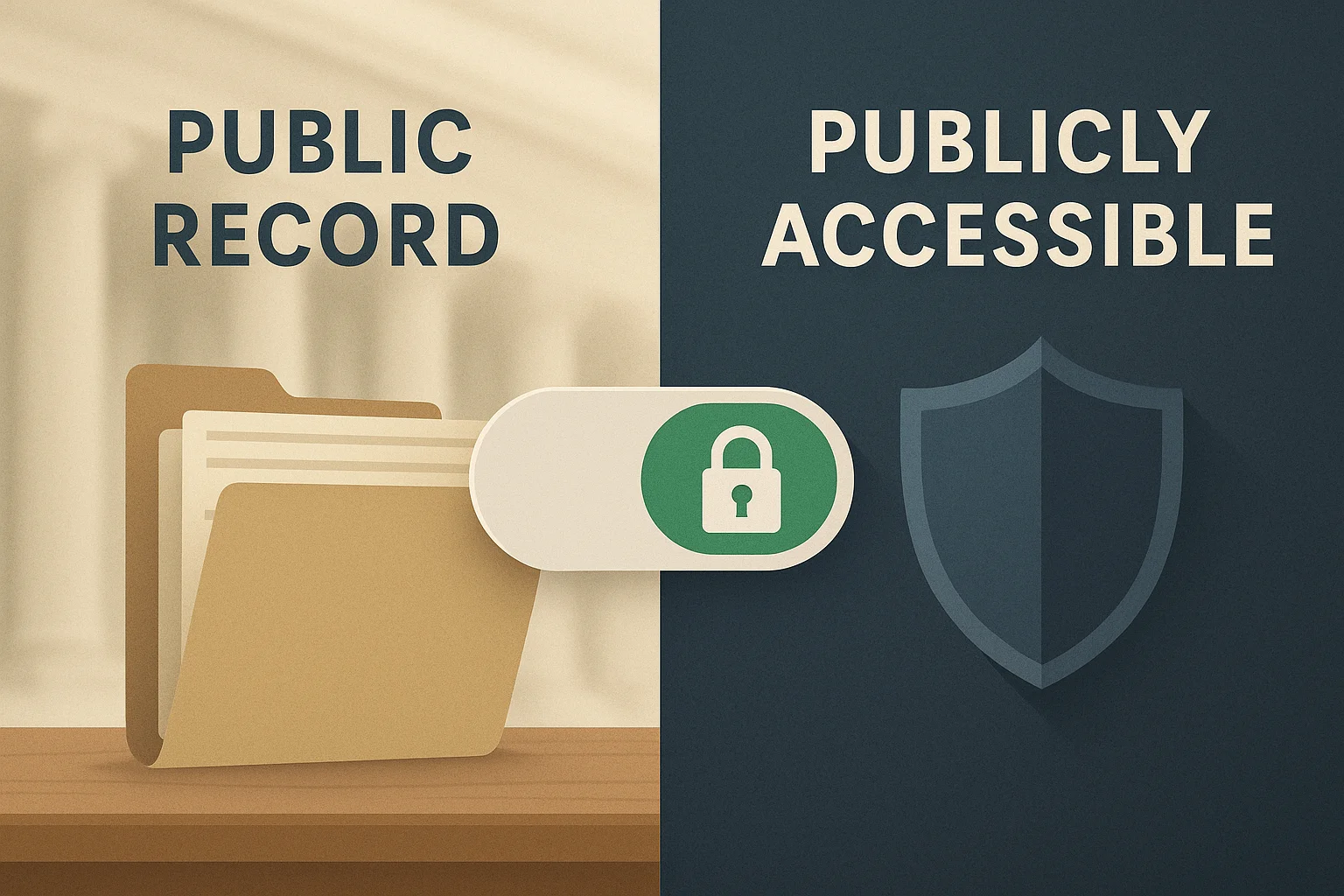
<!-- seo-engine:intro-bridge:end -->The semantic distinction between "public record" and "publicly accessible" represents the critical pivot point where legal strategy transforms information from freely available to restricted: public record means information that technically exists in government files, court documents, agency databases, or official archives following legal processes that create government-maintained records you cannot prevent from existing, while publicly accessible means information you can find through internet search, easily obtain from public databases, discover on people-search websites, or locate through government websites without special access restrictions—the crucial insight is that something can be public record while being completely inaccessible to the general public through legal protections, security classifications, sealing orders, expungement procedures, or redaction mechanisms preventing casual discovery while maintaining official record for legitimate government and legal purposes creating dual-system where record exists for proper legal proceedings while remaining invisible to background checks, employer screening, and casual internet research that depends on public accessibility rather than abstract record existence.
The empowerment pathway begins with understanding which specific information can be removed, sealed, redacted, or expunged through legitimate legal processes rather than accepting fatalist assumption that information remains accessible forever: criminal records can frequently be expunged or sealed eliminating them from background checks and public court databases, personal information on court documents can be redacted replacing your name/address with initials or generic reference, property records can be transferred to trusts or LLCs replacing your personal name with business entity, address information can be replaced with P.O. Box in many jurisdictions, search engine results can be deindexed removing information from Google searches despite records existing in source databases, people-search databases must honor removal requests in many jurisdictions, government records can sometimes be sealed or expunged through legal petitions, and numerous other removal and restriction mechanisms exist creating pathway from "information is out there forever" resignation to active legal strategy systematically eliminating public accessibility despite technical record persistence enabling you to transform your searchable digital presence from completely exposed to substantially restricted through combination of legal procedures, strategic replacements, and database removal requests that passive acceptance prevents you from pursuing.
This comprehensive "public record to private reality" protocol presents systematic methodology for understanding which information CAN be restricted despite public record status, identifying applicable legal mechanisms in your specific jurisdiction, implementing removal procedures, executing strategic replacements preventing future information aggregation, suppressing search engine indexing even where source records persist, and maintaining long-term privacy posture recognizing that perfect erasure is impossible but substantial accessibility reduction transforms practical reality where background checks fail to discover sealed records, people-searches return minimal information, search engines show deleted results, and casual online research discovers nothing despite information technically existing in restricted government files creating genuine privacy protection rather than illusory erasure enabling you to reclaim control over what information you expose to employers, financial institutions, potential connections, and general internet research despite assumptions that nothing can be done once information becomes public record.
Emergency Doxxing Situation?
Don't wait. Contact DisappearMe.AI now for immediate response.
Call: (646) 484-9051
Email: [email protected]
Our team responds within hours to active doxxing threats.
Emergency Doxxing Situation?
Don't wait. Contact DisappearMe.AI now for immediate response.
Call: (646) 484-9051
Email: [email protected]
Our team responds within hours to active doxxing threats.
Deconstructing the "Public Record Means Permanently Accessible" Fallacy
Before implementing record restriction and removal protocol, you must understand precisely why the equation "public record = permanently accessible" is factually incorrect in ways that open legal pathways most people never explore because fatalist misconception prevents investigation of restriction mechanisms that actually succeed at making information difficult or impossible to discover despite its public record status establishing false equivalency that legal systems specifically designed to prevent through expungement, sealing, and redaction procedures representing explicit recognition that public record status doesn't require permanent public accessibility.
The legal distinction between public record and publicly accessible emerges from foundational principle that government creates records serving legitimate governmental functions and legal proceedings while simultaneously recognizing that automatic accessibility to all government records creates privacy harms, security vulnerabilities, stalking risks, identity theft vectors, and other damage warranting protective mechanisms allowing records to exist for proper legal purposes while restricting casual public access through sealing orders, expungement procedures, redaction protocols, and database removal requirements creating nuanced system where information is "public" in sense that it's official record maintained by government but "private" in practical sense that average person cannot discover it through normal channels and background check companies cannot legally access it because restrictions prevent them from obtaining restricted records preventing downstream discovery by employers, financial institutions, or people-searches that depend on database access rather than original source document existence.
The expungement mechanism specifically demonstrates this distinction because expungement literally "deletes" criminal record from public accessibility while government maintains official documentation of case that created expungement for legitimate appeal purposes and judicial oversight, meaning expunged record is genuinely gone from public access (cannot be discovered through any normal search) while technically persisting in sealed government file creating scenario where record is simultaneously "public record" in administrative sense and "completely inaccessible to public" in practical sense representing exactly the distinction that fatalist assumption prevents understanding.
The sealing mechanism similarly creates dual-reality where sealed record technically exists in government files but is prohibited from public disclosure creating situation where sealed record genuinely cannot be accessed by background check companies (because law prohibits them from accessing sealed records), cannot be discovered through internet search (because sealed records are not indexed), and cannot be obtained by curious researchers (because seal prevents disclosure to anyone except specific authorized parties) while the record itself persists in government systems for legitimate legal proceedings and judicial oversight representing conscious legal choice that something can be "public record" while being effectively "inaccessible to public" through protective legal mechanism.
The Google deindexing precedent establishes that even where information genuinely exists on accessible websites maintained by organizations you don't control, Google can remove it from search results based on right-to-be-forgotten principles or legitimate privacy concerns creating scenario where information still exists at original source (government website maintains court record, news article remains on publisher's server, people-search keeps information in their database) while search results show nothing for your name preventing casual discovery despite information technically remaining at original location making information "findable by determined adversary with direct knowledge of where to look" but "undiscoverable to anyone doing standard Google search" representing practical privacy protection even where underlying data persists.
The redaction procedure enables removing personal identifying information from public documents replacing your full name with "J.S." or initials, replacing residential address with "City, State" or P.O. Box, removing Social Security number, phone number, email address, and other identifiers while maintaining document integrity for legitimate record-keeping purposes creating scenario where records exist but contain no information enabling targeted identification or discovery transforming document from "identifies me completely" to "impossible to connect to my identity" despite document remaining in public file.
The address confidentiality program available in many jurisdictions explicitly recognizes distinction between public record and public accessibility by allowing certain protected individuals (domestic violence survivors, stalking targets, witnesses in dangerous cases, etc.) to register with state addressing program receiving substitute mailing address that serves in place of home address on all public records preventing your residential location from appearing on any public document despite record existing at government agency creating systematic approach to removing address from searchable documents while maintaining record-keeping capability.
The trust/LLC replacement strategy for property records demonstrates practical application of public-record-vs-publicly-accessible distinction by enabling property ownership to be registered to business entity rather than personal name removing your identifying information from property records while the property record itself continues to exist creating situation where property record persists but identifies LLC not individual preventing casual discovery of property ownership preventing property searches from connecting property to person and preventing data brokers from correlating property records to personal identity despite record technically remaining in county database.
The fatalist assumption that "nothing can be done" about public records prevents people from pursuing legal mechanisms that actually work because misconception that expungement is impossible, sealing never happens, Google doesn't remove results, redaction doesn't occur, and data brokers don't comply with removal creates resignation where individuals never file expungement petitions they could win, never request record sealing they could obtain, never submit Google removal requests that would succeed, never ask data brokers to remove information they're legally required to delete, and never explore jurisdiction-specific mechanisms that could restrict their information because fatalist assumption prevents effort in pathways that actually succeed at substantial accessibility reduction if not complete erasure.
The critical reframe is shifting from "my information is public record so nothing can be done" to "my information is public record but there are specific legal mechanisms that can make it inaccessible" enabling investigation of applicable removal, sealing, redaction, and expungement procedures transforming resignation into action where you systematically identify what can be restricted, pursue available legal pathways, execute restrictions removing information from searchable databases, and maintain privacy posture recognizing that "permanently accessible" is fatalist fiction while "substantially inaccessible through combination of legal procedures" represents realistic goal achievable through systematic intervention on multiple information sources.
Expungement: Transforming Criminal Records from Accessible to Eliminated
The expungement process represents the most powerful information elimination mechanism available for individuals with criminal history because successful expungement literally removes arrest and conviction records from public access making them undiscoverable through any normal background check, internet search, or casual research despite the underlying events and court proceedings technically persisting in restricted government files available only through specific legal processes creating scenario where person with expunged record can legitimately answer "no" to question "have you ever been convicted of crime" because record has been legally eliminated from public domain even though sealed official file documents the case for legitimate legal purposes.
The expungement eligibility determination varies significantly by jurisdiction but generally depends on several factors: conviction type where some states allow expungement of only certain crimes (often misdemeanors but not felonies, or specific crimes like drug possession where state policy recognizes rehabilitation justification), time elapsed where many jurisdictions require waiting period (1-5 years) between sentence completion or probation end before expungement becomes available recognizing rehabilitation principle, case disposition where some jurisdictions allow expungement of dismissed cases, acquittals, or convictions that were overturned creating eligibility categories beyond completed sentences, criminal history where individuals with additional convictions may be ineligible for expungement or face stricter requirements despite meeting other eligibility criteria, and employment context where certain professions (law enforcement, healthcare, education) may have restrictions preventing expungement of certain convictions or creating complications despite general eligibility.
The state-specific variation in expungement laws requires jurisdiction-specific research because expungement availability and procedures differ dramatically across states: states with robust expungement programs like California, Illinois, Texas, and Colorado have relatively broad eligibility allowing expungement of many convictions with reasonable waiting periods enabling substantial criminal record elimination, states with limited expungement like New York primarily use sealing rather than expungement for most cases leaving records technically accessible despite sealed status creating ongoing background check vulnerability, states with restricted eligibility like some southern jurisdictions limit expungement to specific offenses or require longer waiting periods restricting accessibility improvement pathway, and federal crimes subject to federal sentencing rules sometimes have different expungement eligibility than state crimes requiring separate federal petition processes creating additional complexity.
The practical expungement procedure generally involves: eligibility verification determining whether your conviction qualifies for expungement under applicable state law by consulting with criminal defense attorney or using state public defender resources confirming eligibility before investing effort in petition process, petition preparation assembling required documentation (certified conviction records, case disposition documents, proof of sentence completion, character references if required by jurisdiction), petition filing submitting expungement petition to court where conviction occurred with required supporting documentation and filing fees (typically $50-500 depending on jurisdiction), waiting period if applicable state requires specific time after sentence completion before expungement eligibility creating delay preventing immediate removal, court determination where judge reviews petition and determines whether to grant expungement based on statutory criteria (rehabilitation, impact of record on employment, public safety consideration) with decision sometimes requiring judicial discretion making outcome less certain than administrative removal, and record destruction if expungement granted where court orders destruction of arrest records, conviction records, fingerprints, photos, DNA samples, and related materials with affected agencies required to comply within specific timeline (typically 30-90 days).
The post-expungement effect where expungement literally removes records from public access creating scenario where background check companies cannot legally access expunged records (because law prohibits them from accessing or disclosing expunged records), criminal history searches show no record (because records have been destroyed), courts must respond to inquiry about conviction with "no record found" (because record was destroyed), and individual can legally answer employment questions about criminal history with truthfulness stating no conviction exists (because conviction has been legally eliminated) creating comprehensive accessibility elimination despite underlying events technically documented in sealed court files for limited purposes enabling individuals to answer "have you ever been convicted" with legally truthful "no" when expungement has destroyed public record.
The challenges to expungement that prevent pursuit despite availability include: attorney cost where criminal defense attorney required to file petition charges $500-2,000+ creating barrier for individuals unable to afford legal representation despite many jurisdictions offering public defender services for expungement petitions, time investment spanning months from petition filing through decision and record destruction making expungement not immediate solution for urgent employment or background check concerns, judicial discretion where some judges exercise discretion denying expungement even for eligible cases creating uncertainty about outcome despite technical eligibility, awareness gaps where most individuals with expungeable convictions never learn about option because public education about expungement availability is minimal leaving fatalist assumption that conviction record persists forever, and state variation making process unclear across jurisdictions requiring jurisdiction-specific legal guidance creating research burden preventing self-help expungement in some areas.
Sealing: Restricting Access While Maintaining Official Record
Where expungement completely eliminates records from public access, sealing creates restricted access where records remain in government systems but become inaccessible to public through legal protective order preventing background check companies, employers, data brokers, and casual researchers from accessing sealed records creating scenario where record technically exists but is effectively unavailable for employment screening, background research, or casual discovery representing alternative pathway where records aren't destroyed but are genuinely inaccessible to normal channels.
The sealing mechanism establishes court order requiring records be sealed preventing public access while maintaining official documentation for legitimate judicial and legal purposes creating bifurcated system where records exist for procedural integrity and appellate review while being invisible to employment background checks and internet research enabling individual to maintain truthful career narrative where sealed records don't appear in background checks making sealed conviction functionally equivalent to non-conviction for employment purposes despite technically existing in restricted court file.
The sealing availability and procedures vary by jurisdiction similarly to expungement but generally require: petition for sealing filed with court requesting records be sealed citing privacy, rehabilitation, employment impact, or other grounds supporting sealed access, judicial review where judge determines whether sealing is appropriate balancing public interest in access against individual's privacy interest and rehabilitation principle, sealing order if judge grants request prohibiting public access and requiring agencies to maintain confidentiality, and partial accessibility to specific authorized parties (defendant, attorney, judiciary, law enforcement with court order) while preventing general public and background check company access creating restricted access rather than complete elimination.
The critical advantage of sealing vs. expungement is that sealing is more readily available in jurisdictions where expungement is restricted because sealing requirements are often less stringent, available for broader range of convictions, and sometimes available even before sentence completion where expungement requires specific waiting period making sealing practical pathway in jurisdictions with limited expungement enabling substantial accessibility restriction even where complete record elimination isn't available legally.
Turn Chaos Into Certainty in 14 Days
Get a custom doxxing-defense rollout with daily wins you can see.
- ✓✅ Day 1: Emergency exposure takedown and broker freeze
- ✓✅ Day 7: Social footprint locked down with clear SOPs
- ✓✅ Day 14: Ongoing monitoring + playbook for your team
Redaction: Removing Identifying Information from Documents
Redaction procedures enable removing personal identifying information from court documents, property records, land records, and public filings replacing your personal identifying information with generic reference or initials preventing document-specific discovery while keeping records intact for legitimate record-keeping purposes creating practical accessibility reduction where documents exist but cannot be connected to your identity through normal search.
The redaction implementation involves: identifying documents requiring redaction reviewing which public documents contain your personal identifying information (court documents showing address, social security number, phone number; property records showing personal name; financial records showing account information), contacting relevant agencies (county clerk, court system, county recorder) requesting redaction of personal information and explaining privacy or security justification, submitting redaction requests with specific document identification and detailed explanation of which information should be redacted and why, verification of redaction confirming that redacted documents are updated in both physical files and online databases because some agencies maintain information in multiple locations requiring separate redaction requests, and ongoing maintenance requesting redaction for future documents that might contain identifying information preventing new documents from recreating exposure you eliminated from historical records.
Strategic Information Replacement: Prevention Through Substitution
Beyond removal and restriction of existing information, strategic replacement prevents future information from being connected to your personal identity by using alternative identifiers reducing future exposure: P.O. Box replacement for residential address on all government documents, voter registration, utility accounts, and new filings enabling documents to reference P.O. Box rather than home address preventing residential location disclosure, trust/LLC entity replacement for property ownership and business dealings enabling property to be owned by business entity rather than personal name removing personal identifying information from property records while maintaining legitimate ownership documentation, middle initials or limited name usage on documents where full name isn't essential preventing full name from appearing in searchable databases where abbreviated name cannot be connected to individual identity without additional information, phone number management using separate phone lines or numbers for specific purposes preventing single phone number from appearing across all records enabling data brokers to correlate different aspects of identity through single number connection.
Frequently Asked Questions About Public Record Restriction
Can I really get criminal records expunged or is that just marketing hype?
Expungement is absolutely real legal mechanism available in most states though availability, eligibility requirements, and procedures vary significantly by jurisdiction. Many states have robust expungement programs with substantial portion of eligible individuals successfully obtaining expungement though awareness gaps prevent many eligible people from pursuing it. The process is not instantaneous (typically 3-6 months from petition through record destruction) and sometimes requires attorney representation creating cost barrier ($500-2,000), but expungement genuinely results in record destruction and removal from background check access creating legitimate pathway to elimination rather than mere reduction. For individuals with criminal history eligible under their state law, expungement represents potentially transformative opportunity eliminating record from employers' reach despite fatalist assumption that conviction record is permanent disability.
If I seal records, can employers still find out about them in background checks?
Sealed records are genuinely inaccessible to background check companies because law prohibits them from obtaining or disclosing sealed information making sealed conviction records undiscoverable through standard employment screening. However, certain employers (law enforcement, government positions, financial institutions, professions requiring specific licenses) sometimes have access to sealed records through back-door channels or can request unsealing through court, and sealed conviction may still appear on personal background report if you're checking your own records (most people-search sites and background check services include sealed convictions in reports to individuals though not to employers). The key distinction is that sealed records are inaccessible to most employers through standard hiring process making sealed conviction functionally invisible for most employment purposes though it technically exists in restricted file and might be visible to you or limited authorized parties.
Can I really get Google to remove information about me even if it's public record?
Google has removed millions of search results based on right-to-be-forgotten principles, privacy concerns, and specific legal requests particularly for sensitive information like addresses, phone numbers, financial information, or other personally identifiable information on public record but not requiring public indexing in search results. Google's removal request process assesses whether information meets specific criteria (sensitive personal information, security risks, legitimate privacy concerns) and removes many requests particularly where information is easily obtainable elsewhere if searcher knows where to look but not easily discoverable through search. The success rate depends on information type and justification, but Google removal represents legitimate mechanism preventing casual discovery even where underlying information persists at original source making information findable only by people specifically seeking it rather than discoverable to anyone Googling your name.
What are address confidentiality programs and who qualifies?
Address confidentiality programs exist in most states enabling certain protected individuals (domestic violence survivors, stalking victims, witnesses in dangerous cases, individuals with legitimate safety concerns) to register with state program receiving substitute mailing address that appears on all public records in place of home address preventing residential location disclosure on any public document. Eligibility varies by state but generally focuses on individuals facing safety risks from disclosure making address protection part of protective order or threat mitigation. Qualification typically requires application to state program with supporting documentation of threat or safety concern and some programs provide substitute address through state agency while others allow use of P.O. Box or commercial mailbox service. For individuals genuinely facing safety risks, address confidentiality program provides legitimate mechanism preventing home address from appearing on any public record.
How long does expungement/sealing process typically take?
Timeline varies significantly by jurisdiction but generally ranges from 3-6 months from petition filing through final record destruction though some jurisdictions have longer processing times (6-12 months in heavily burdened courts) and others process faster (2-3 months in efficient jurisdictions). The process typically includes: 1-2 weeks for petition preparation, 1-4 weeks for court processing after filing, potential 1-3 month waiting if case requires judicial hearing or objection review, and 1-2 months for agencies to destroy records after order issued. For urgent situations where employment decision depends on quick expungement, consult with attorney about whether expedited processing is available or whether interim protective measures (interim sealing request, employment notification of pending expungement) can address immediate concern while full expungement processes.
What happens to sealed/expunged records if I'm arrested again?
For most purposes, sealed and expunged records are treated as non-existent meaning they won't appear in normal background checks or employment screening even if you're subsequently arrested. However, law enforcement retains access to sealed records for investigation purposes and sealed records may be unsealed if new charges are filed against you or in certain legal proceedings where sealed records become relevant. Additionally, subsequent conviction may create new barrier to expungement of sealed record depending on jurisdiction, and sealed record from previous case may still exist (even if sealed) when evaluating eligibility for expungement of new conviction. The key point is that sealed/expunged record won't interfere with new employment or background screening but may complicate future legal proceedings if record needs to be unsealed for legitimate legal reasons.
Can I remove my address from property records?
Direct removal of address from property records is generally not available (property records must document location to fulfill legitimate recording function) but strategic replacement through trust or LLC ownership can remove your personal name from property records replacing it with business entity name preventing property record from identifying you specifically. Additionally, address confidentiality programs allow replacing home address with substitute address on some property documents, and requesting redaction of address from specific property documents in some jurisdictions can partially remove residential location exposure from searchable databases though eliminating address from all property records is typically not feasible as property location is essential information property records must contain requiring alternative strategies for address protection rather than complete address removal from public record.
Is it legal to use a trust or LLC to hide property ownership?
Yes, using trust or LLC for property ownership is completely legal and commonly used for legitimate privacy, asset protection, liability reduction, and estate planning purposes not requiring any concealment or misrepresentation. Property ownership through business entity is transparent to government (business entity must be registered and documented), legitimate creditors, and legitimate inquiries while simply preventing casual discovery of personal name connection to property through basic property record search. Using trust or LLC doesn't hide information from law enforcement, government agencies, or legitimate legal inquiries that can trace business entity ownership to individual through corporate documents, but it prevents data brokers and casual researchers from easily connecting property to personal identity through property record searches making it practical privacy strategy that doesn't require concealment or fraud.
Threat Simulation & Fix
We attack your public footprint like a doxxer—then close every gap.
- ✓✅ Red-team style OSINT on you and your family
- ✓✅ Immediate removals for every live finding
- ✓✅ Hardened privacy SOPs for staff and vendors
References and Further Reading
How to Remove Public Records: An 8-Step Guide - Incogni
Data Privacy Guide (2025)
Comprehensive step-by-step methodology for removing public records from multiple sources including county clerk, DMV, courts, and data brokers.
Remove Information From People Search Sites - Consumer Reports
Consumer Guidance (2024)
Practical guide for removing personal information from people-search databases with platform-specific procedures.
How to Remove Your Information From People Search Sites - Experian
Credit Bureau Guidance (2024)
Information removal procedures from major people-search platforms with realistic expectations about process.
How To Remove Public Records From The Internet - OneRep
Data Removal Guide (2025)
Step-by-step public record removal including county clerk office procedures, DMV processes, and court record removal.
Sealed Criminal Records - New York Courts
Government Official Information (2022)
State-specific guidance on criminal record sealing with explanation of limitations and restricted access.
How to Seal Criminal Records in New York City - NYC Bar
Bar Association Legal Guidance (2025)
Legal process for sealing criminal records with detailed procedural requirements and qualifying factors.
Removing Records from Both Public and Private Databases - RecordGone
Record Removal Services (2024)
Analysis of public and private database removal procedures and how court orders affect database updates.
Formalizing Data Deletion in the Context of the Right to be Forgotten - arXiv
Academic Research (2020)
Formal definition of data deletion and right-to-be-forgotten legal framework with implications for record removal.
Are Public Records Too Public? - Semantic Scholar
Academic Analysis (2024)
Critical examination of public record accessibility policies and case for removing personally identifying information from online versions of court documents.
Remove My Private Info From Google Search - Google Support
Official Google Procedure (2025)
Google's official process for requesting removal of personally identifiable information from search results.
ExD: Explainable Deletion - ACM Digital Library
Computer Science Research (2023)
Academic analysis of data deletion mechanisms, transparency gaps, and right-to-be-forgotten implementation challenges.
Control, Confidentiality, and the Right to be Forgotten - arXiv
Academic Research (2023)
Formal treatment of data deletion definitions and machine unlearning in context of privacy rights framework.
Improving Privacy Benefits of Redaction - arXiv
Latest Research (2025)
Novel redaction methodology for protecting privacy while maintaining document accessibility for legitimate purposes.
About DisappearMe.AI
DisappearMe.AI provides comprehensive privacy protection services for high-net-worth individuals, executives, and privacy-conscious professionals facing doxxing threats. Our proprietary AI-powered technology permanently removes personal information from 700+ databases, people search sites, and public records while providing continuous monitoring against re-exposure. With emergency doxxing response available 24/7, we deliver the sophisticated defense infrastructure that modern privacy protection demands.
Protect your digital identity. Contact DisappearMe.AI today.
<!-- seo-engine:related-reading:start -->Related Reading
- How to Disappear from Public Records: 15 Legal Strategies to Erase Your Name from Databases in 2025
- Why the Average Person Doesn't Know Where Their Data Is Exposed: The Ultimate Guide to Disappear, How to Disappear, and How to Go Off the Grid in 2025
- The Complete Guide to Disappearing From the Internet: 12 Strategies to Reclaim Your Digital Privacy in 2025
Take the Next Step
If you want DisappearMe.ai to handle the database deletion wave and ongoing leakage monitoring for you, start with a Features and review Pricing.
<!-- seo-engine:next-step:end --> <!-- seo-engine:references:start -->References and Further Reading
<!-- seo-engine:references:end -->Related Articles
Why the Average Person Doesn't Know Where Their Data Is Exposed: The Ultimate Guide to Disappear, How to Disappear, and How to Go Off the Grid in 2025
Learn exactly where your data is exposed across 140+ brokers and how to disappear completely. Expert guide on how to go off the grid, remove all traces, and vanish from the internet with DisappearMe.AI in 2025.
Read more →How to Disappear from Public Records: 15 Legal Strategies to Erase Your Name from Databases in 2025
Learn how to disappear from public records completely. Master the 15 legal strategies for erasing your name from property deeds, court records, voter files, and government databases permanently.
Read more →The Complete Guide to Disappearing From the Internet: 12 Strategies to Reclaim Your Digital Privacy in 2025
Learn 12 powerful strategies to remove your digital footprint, erase personal data from data brokers, delete old accounts, and achieve true online privacy and anonymity.
Read more →